
The biomechanical testing platform is an infrastructure dedicated to the study of the mechanical properties of biomaterials, medical implants, and biological tissues. Equipped with state-of-the-art equipment and specialized expertise, this platform allows for simulating and analyzing the behavior of materials under various mechanical stresses, in conditions close to those of the human body.
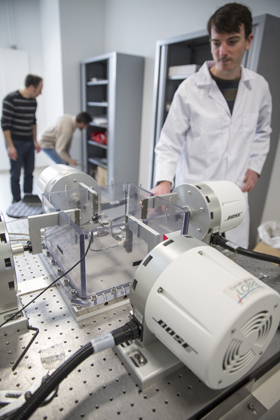
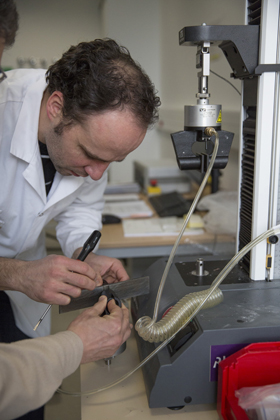
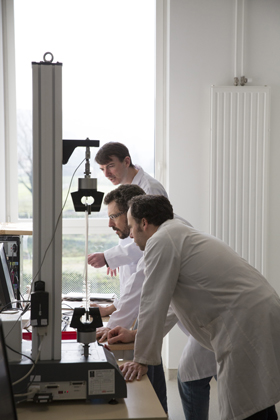
Platform Objectives
- Characterize the mechanical properties of biomaterials and implants to ensure their reliability and mechanical biocompatibility.
- Analyze the behavior of biological tissues (bones, cartilage, membranes, soft tissues) to better understand pathologies and tissue repair.
- Validate the performance and durability of medical devices (MDs) according to preclinical and regulatory requirements.
- Optimize the design of bio-inspired implants by reproducing complex physiological stresses.
Equipment and Techniques
The platform features advanced technological equipment for detailed analysis of biomechanical properties.
- Tensile/Compression and Flexural Testing Machines
Static and dynamic analysis of rupture limits and elastic moduli. - Fatigue and Wear Test Benches
Simulation of long-term cyclic loading (several million cycles) to evaluate the lifespan of prostheses. - Multi-axial and Bi-axial Testing Devices
Study of materials under complex stresses (torsion, biaxial tension) to accurately reproduce human movements. - Thermoregulated Chambers and Physiological Environments
Tests performed in immersion (physiological liquid, 37°C) to simulate the in vivo environment. - High-Resolution Instrumentation
Digital Image Correlation (DIC), force sensors, and nanometric displacement sensors.
Applications
The biomechanical testing platform offers various applications for academic, industrial, and medical sectors.
- Validation of orthopedic and vascular implants
Testing of hip and knee prostheses, stents, and arterial substitutes. - Soft Tissue Engineering
Study of skin fragility, vascular walls, or ligaments. - Characterization of innovative biomaterials
Evaluation of hydrogels, composites, and bioresorbable polymers. - Surgical Decision Support
Experimental modeling to optimize implant placement techniques.
Partnerships and Impact
The biomechanical testing platform collaborates with:
- Academic laboratories to deepen research on biomaterials and implants.
- Hospitals to validate medical devices under preclinical conditions.
- Industrial partners specializing in orthopedic devices and innovative materials.
This work directly contributes to:
- Improving the durability and safety of orthopedic implants for clinical use.
- Designing more efficient and biocompatible biomedical materials.
- Developing innovative solutions for tissue regeneration and musculoskeletal pathologies.
Contact
Head of the Biomechanical Testing Platform
The biomechanical testing platform is an essential infrastructure for validating the performance of biomaterials and medical devices, ensuring innovative, safe, and adapted solutions to clinical and industrial requirements.