Process Design for Energy and Environment, from fundamentals to technology
The Centre for Chemical Engineering (SPIN) at Mines Saint-Étienne develops research and training activities in the field of process engineering applied to dispersed systems: grains, particles, drops, bubbles, porous media, and more. It studies material transformation, recovery and recycling processes, geological and water resource management, and environmental challenges related to the industries of the future.
Director
Ana Cameirao
Email
cameirao@mines-stetienne.fr
Scientific Objectives
The SPIN center aims to design innovative solutions for more efficient, resource-efficient, and environmentally friendly processes. It relies on strong expertise in modeling, numerical simulation, experimentation, and multi-scale characterization. It contributes to the emergence of sustainable industrial systems, adapted to the challenges of the circular economy and energy transition.
Research Areas
The research activities of the SPIN Centre fall within the field of Process Engineering, with both experimental and modeling approaches. They cover six major areas, focused on understanding and mastering dispersed systems (grains, droplets, bubbles, particles) in industrial or geological contexts. The center utilizes advanced experimental tools and develops predictive models to understand the behavior of these systems at different scales.
Powder Technologies
The objective is to establish the link between macroscopic properties (flowability, reaction progression, etc.) and the microscopic characteristics of particles (size, shape, composition) as well as those of the carrier fluid (flow regime, temperature, pressure, composition, etc.).
These applications include:
- to powders and grains in gaseous media,
- to concentrated pastes such as cements and concretes.
Powder Reactivity
This research area aims to understand, model, and control gas-solid reactions, which are essential in many industrial processes (additive manufacturing, chemistry, metallurgy, energy, etc.). The work focuses on characterizing chemical reactivity, identifying reaction mechanisms, modeling transformations in solids, and simulating industrial reactors.
Image analysis plays a central role in characterizing dispersed media (particles, bubbles, droplets), using advanced methods for detection, measurement, and modeling. These tools enable the generation of digital twins to better understand system evolution and optimize processes at different scales.
Gas Sensors
Research activities focus on the electrical properties of solids interacting with gases, and from an application perspective, involve the development of gas and particle sensors.
This work focuses on the electrical properties of solids interacting with gases, with the aim of developing high-performance gas and particle sensors.
Research areas include:
- the modeling of gas-solid interactions,
- the design of chemical sensors based on semiconductor materials or ionic conductors (via screen printing, inkjet, etc.),
- the laboratory and on-site characterization (test benches),
- the data processing and analysis.
Geo-processes
This research area explores the interactions between geological systems and industrial processes, with an interdisciplinary approach rooted in sustainability challenges.
It includes three sections:
- Phytomanagement: use of plants to stabilize pollutants in soils and as indicators of metal contamination.
- Hydrogeology: modeling of water flows, aquifer vulnerability, and decision-making tools for water resource management.
- Hydrometallurgy: design and optimization of processes for the recovery of solid materials (ores, waste, soils) and the recycling of effluents.
Crystallization
This research area aims to understand and model crystallization phenomena, from thermodynamics to the kinetics of processes such as nucleation, growth, agglomeration, and fragmentation. Research also focuses on the influence of stirring conditions and reactor geometry on crystal size distribution.
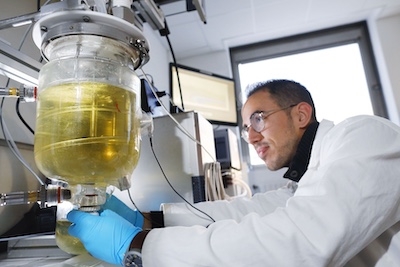
The work relies on multi-instrumented reactors, ranging from laboratory scale to semi-industrial pilots, equipped with FBRM, ATR-IR, Raman probes, microscopes, and online chromatographs. Applications include the precipitation of mineral species, the formation of gas hydrates for air conditioning, CO₂ capture, water treatment, and flow assurance in offshore oil transportation.
Image Analysis
This research area develops methods for processing, analyzing, and modeling images of dispersed media (particles, droplets, bubbles, pores), with the aim of characterizing materials and processes.
The work focuses on:
- Image Processing: simplification of images to identify objects of interest via techniques such as filtering and thresholding.
- Morphological Analysis: measurement of object characteristics (size, shape, dispersion) for quantitative description.
- Geometric Modeling: generation of synthetic images (digital twins) reproducing the statistical properties of real images, enabling robust extraction of information on object size and shape.
Areas of Expertise
Core Competencies
- Dynamics of heterogeneous and granular systems.
- Multi-physics and multi-scale modeling, from nm3 to km3.
- Multiphase transfers, physicochemical characterizations, in-situ analyses.
- Technological developments: from instrumentation to process.
- Application areas: energy, eco-efficient factories, surface geosciences
Application Domains
- Among the application areas are materials (high-performance and low CO2 impact cements, bio-sourced composite materials…), energy (nuclear fuel manufacturing and recycling, oil production, energy storage…), and environment (soil and wastewater depollution, gas and atmospheric pollutant sensors, groundwater and aquifer monitoring).
These interventions take the form of industrial collaborations, collaborative research projects, research-based training, and technology transfers, serving innovation and competitiveness.
Center Members
Under the direction of Ana Cameirao, accompanied by deputy director Éric Serris, the SPIN center relies on a multidisciplinary team that constitutes an essential pillar of the School’s research, training, and technology transfer activities.
- 48 permanent staff: 22 research faculty, 25 administrative and technical staff.
- 31 doctoral and postdoctoral researchers, actively contributing to the innovative research projects conducted by the center.
Video presentation of the Centre
Contact and Practical Information
- Director
Ana Cameirao
Email
cameirao@mines-stetienne.fr
Phone
+33 4 77 42 02 86
- Deputy Director
Éric Serris
Email
eric.serris@mines-stetienne.fr
Phone
+33 4 77 42 02 90
- Address
Mines Saint-Étienne
Centre for Chemical Engineering
158, cours Fauriel,
42000 Saint-Étienne, France
- Transport
Bus: Line 6, stop “École des Mines”
Related Articles