
The Royal Ordinance of 2 August 1816
Following the fall of the First Empire in 1815, the Treaty of Vienna separated Saarland and Savoy from France, depriving the country of the practical mining schools of Geislautern and Pesey just as the Industrial Revolution was emerging. At that time, France faced a growing need for skilled professionals to support coal extraction.
On August 2, 1816, during the reign of Louis XVIII, a royal decree marked the creation of a School of Miners in Saint-Étienne, a city then in full expansion thanks to the exploitation of its rich coal deposits.
This ordinance marked the creation of the oldest school in the Auvergne-Rhône-Alpes region, strategically located near the coal mines of the Loire department. Initially, its mission was to train master miners.
Its first motto, “Operta Naturae Inveniunt Munera” (“They reveal the hidden works of Nature”), reflected the pioneering spirit of those destined to master and harness the Earth’s resources.
From a School of Miners to a Prestigious Engineering Institution
On 7 March 1831, a new royal ordinance transformed the institution into a fully-fledged engineering school, paving the way for the education of those who would shape the industrial future of France.
Over time, the École nationale supérieure des mines de Saint-Étienne has grown into one of France’s most prestigious engineering schools, with a strong emphasis on the connection between research and education and a close relationship with industry.
The expansion of the mining industry, the growing number of alumni, the high-level positions they attained, the quality of education provided, and the influential leadership of key directors have all contributed to this evolution.
A School Established in the Heart of Saint-Étienne
Originally, the school was housed in a modest building on Place Marengo, primarily training master miners. However, with the expansion of the mining industry and the growing need for specialised training, the location quickly became unsuitable.
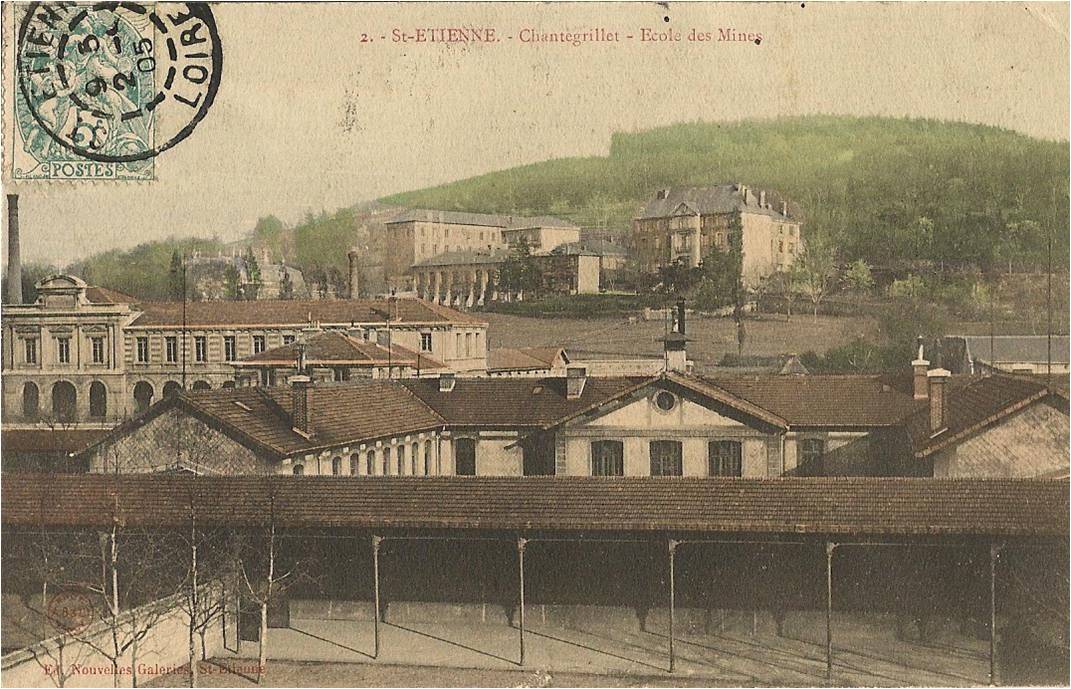
In 1848, the school relocated to the Chantegrillet estate, which had been donated by the Brothers of the Christian Schools. Unfortunately, nearby mining activity compromised the structural integrity of the buildings, leading to another relocation in 1927 to Cours Fauriel, where the school remains to this day.
This new site earned the school the nickname “La Grande Dame du Cours Fauriel”.
Research, Innovation, and Global Outreach
The School has always been at the forefront of innovation. Initially, its activities focused on chemistry and metallurgy, but it turned very early toward computer science, and later toward health engineering and environmental challenges.
This evolution reflects its ability to address contemporary issues and anticipate market needs.
The year 1987 constituted a major turning point with the first international agreement signed with the Technical University of Berlin, marking the beginning of an era of international cooperation. This momentum was reinforced by the signing of the first double-degree agreement in 1993. Today, Mines Saint-Étienne has established more than 140 agreements and conventions with academic institutions worldwide.
In 2002, the School embraced the microelectronics revolution and established a presence in Gardanne, in the Bouches-du-Rhône, to open the Centre of Microelectronics in Provence, which was inaugurated in 2008. At this new site, the Aix-Marseille-Provence campus, the school developed a new degree program in systems, microelectronics, and computer engineering (ISMIN). The CMP is dedicated to research and education in the field of microelectronics, with a particular focus on cutting-edge technologies such as flexible electronics, health sensors, and the Internet of Things (IoT). Today, the CMP is a key player in microelectronics for the Sud region, supporting academic research, technological innovation, and the training of future specialized engineers (ISMIN) in this strategic sector for France and Europe.
In 2003, the school surpassed 1,000 students for the first time.
In 2004, Mines Saint-Étienne established the Centre for Biomedical Engineering & Healthcare (CIS), a research and education centre dedicated to engineering and healthcare. Located on the Campus Santé Innovations, in collaboration with Saint-Étienne University Hospital (CHU) and the Faculty of Medicine, it fosters strong synergies with hospitals and industry partners. Its primary mission is to improve healthcare through science and engineering, leading applied research projects in biomechanics, biomaterials engineering, and healthcare system optimisation. The CIS has become a key player in the development of innovative medical technologies and the training of future healthcare experts, establishing itself as a leader in translational research and technology transfer, serving public health advancements.
En 2010, la création de l’Institut Henri Fayol, a pour objet l’étude, l’expérimentation et la promotion de bonnes pratiques et de modèles de performance pour les entreprises.
In 2021, Mines Saint-Étienne and its partners created Diwii, a technology platform located on the Campus Région du Numérique in Charbonnières-les-Bains, near Lyon. Its mission is to support industries in their innovation journey, whether in technology, organisation, human resources, or environmental sustainability.
The inauguration of the MedTechLab in 2021 marked a significant milestone for Mines Saint-Étienne in advancing its health innovation projects.
Located on the Campus Santé Innovations in Saint-Priest-en-Jarez, the MedTechLab is a living lab dedicated to the real-world experimentation of innovative products and services, with a particular focus on health technologies and senior autonomy.
The MedTechLab stands out for its Open Innovation approach, involving users (notably seniors) to co-create the technologies of tomorrow, making it a unique example in France of collaboration between an engineering school and a mutualist group, Aésio Santé.
The inauguration of Château Laurin in 2022 on the Aix-Marseille-Provence campus marked a new chapter for Mines Saint-Étienne. This 20th-century Provençal building was renovated to become an emblematic centre for innovation and entrepreneurship. Today, Château Laurin houses the Team Mines Saint-Étienne programme, which supports the technological maturation of startups and young innovative companies. The site also hosts partners and the Mines Saint-Étienne Alumni office, fostering a synergistic environment between innovation, research, and entrepreneurship.
Remarkable Figures Who Shaped History
Louis BEAUNIER (1779 – 1835)
Louis Beaunier was the first director of the École des Mines de Saint-Étienne. Appointed in 1816, he gradually transformed the institution from a training school for master workers into a civil engineering school.
A General Inspector of Mines and an industrial pioneer, Beaunier is credited with founding France’s first railway. Born in Melun in 1779, he passed away prematurely in 1835, leaving his mission unfinished.
A visionary leader and a dedicated servant of the nation, he conducted the first topographical study of the coal basin in 1812, marking a major milestone in mining and industrial development.
Benoît FOURNEYRON (1802 – 1867)
Benoît Fourneyron was a student and the top graduate of the first class of the École des Mines de Saint-Étienne, which at the time had only eight students.
He is the inventor of the hydraulic turbine and director of the Creusot and Bois d’Avaize mines.
In 1821, while in Saint-Étienne, he studied the route for France’s first railway (Saint-Étienne – Andrézieux).
He also played a key role in the production of tinplate, which was previously an English monopoly.
In 1831, he presented a treatise on hydraulic turbines, a groundbreaking innovation of the 19th-century European technological revolution.
At that time, the turbine was the most remarkable product of the wave of technological innovations sweeping across 19th-century Europe.
It enabled the revitalisation of old industrial sites and provided hydropower with new advantages over steam engines.
Jean-Baptiste BOUSSINGAULT (1802 – 1887)
A student of the second graduating class of École des Mines de Saint-Étienne, Jean-Baptiste Boussingault distinguished himself as both a scientist and explorer.
In 1822, he entered the service of Colombia, where he conducted scientific explorations. Upon returning to France, he taught at the Faculty of Sciences in Lyon and later at the Conservatoire des Arts et Métiers in Paris.
A pioneer in agricultural chemistry, his research laid the foundations of modern organic science. In 1875, he developed the first chrome steels, marking the birth of industrial laboratories—a milestone that would shape the future of specialty steel production.
Félix DEVILLAINE (1822 – 1913)
Félix Devillaine (Class of 1846)
Félix Devillaine epitomises the civil engineer archetype.
At the turn of the 20th century, he solved the challenge of extracting thick coal seams by pioneering the backfilling method in mining operations.
Henri FAYOL (1841 – 1925)
The work of Henri Fayol was monumental. Not only was he a prominent leader in mining and industry, but he was also regarded as an “apostle of common sense”.
A prototype of the generalist engineer and a director of a major industrial company of his time, Fayol published a groundbreaking article in 1916, titled Administration Industrielle et Générale, just five years after Taylor’s Principles of Scientific Management. He was the first to develop a comprehensive theory of organisational management, aimed at business leaders.
One of his significant contributions to mining was his study on combating underground fires, reflecting his deep expertise in mine safety and operations.
Jean-Baptiste MARSAUT (1832 – 1914)

Jean-Baptiste Marsaut graduated top of his class in 1852.
He spent most of his career in Bessèges, Gard, where, at just 29 years old, he became the director of a mine producing 300,000 tonnes per year.
A brilliant inventor, he developed methods for washing and purifying coal, leading to a five-year legal battle with his competitor Maximilien Evrard.
However, his greatest legacy is undoubtedly the Marsaut safety lamp, which still adorns the main entrance of École des Mines de Saint-Étienne today.
Throughout his life, improving mine lighting and preventing firedamp explosionsremained his primary concern.
Louis TAUZIN (1856 – 1921)
At just 27 years old, Jean-Baptiste Marsaut became a professor at the École des Mines. In 1891, he was appointed Deputy Director, and two years later, in 1893, he became Director, a position he held until 1907, when he was promoted to General Engineer of Mines.
In May 1898, he had the honour of welcoming French President Félix Faure to the Chantegrillet campus.
He also served as President of the Société de l’Industrie Minérale from 1898 until his death in 1921, leaving a lasting impact on the mining industry and academia.
Ludovic BRETON (promotion 1862)
Ludovic Breton was the Director of Excavation Works for the first Channel Tunnel project.
Pierre TERMIER (1859 – 1930)
Pierre Termier was a professor at the École des Mines de Saint-Étienne from 1885 to 1894, a member of the Institut, a renowned geologist, and an avid mountaineer.
In 1894, he left Mines Saint-Étienne to join the École des Mines de Paris, and in 1909, he was inducted into the Académie des Sciences.
A passionate geologist and alpinist, he achieved the first ascent of Roche de Jabel (3,602 m). The Roc Termier, a peak in the Galibier mountain range, was named in his honour.
Pierre CHEVENARD (1887 – 1960)
Recruited by Henri Fayol in 1911, Pierre Chevenard was entrusted with a critical mission: “gather and, if necessary, create experimental tools, establish investigative methods, systematically explore alloys; then, using this knowledge, develop new metallurgical products to meet the evolving needs of industry.”
As part of this work, he discovered and experimented with the dilatometric machine (1916) and micromachines for testing materials.
From 1919, he held the Chair of Metallurgy at the École des Mines de Saint-Étienne and contributed to the Cercle d’Étude des Métaux.
In 1946, he was inducted into the Académie des Sciences, recognising his significant contributions to metallurgical research and industrial innovation.
Marcelle Schrameck (1896 – 1965)
Marcelle SCHRAMECK, born on June 4, 1896, in Paris, is a prominent figure in the history of women in the field of engineering in France. She was the first woman to enter a Grande École of engineering, Mines Saint-Étienne, in 1917, and graduated in 1919. At that time, her admission was a true challenge, given that engineering schools were exclusively male. Indeed, the school’s Board of Directors initially refused her application but finally yielded under pressure from the Ministry of Public Works, which considered that during wartime, training women for engineering positions was necessary due to the mobilization of men at the front.
After graduating, Marcelle joined the Kuhlmann chemical plant in Lorraine in 1920, then followed her husband Louis Kahn to Brest, Saigon, and Lorient. During the Second World War, due to their Jewish origins, Marcelle and her husband had to flee raids and went into exile, holding various administrative positions in Algiers and Paris. Despite the difficulties, she always demonstrated determination and courage in a professional world largely dominated by men.
Her admission to the School of Mines remained unique for more than half a century. After her time there, no other woman was admitted until 1968, and it was only from 1971 that the school officially reopened its doors to women. Marcelle thus remained an exception for a long time, marking the history of this institution through her determination and pioneering commitment.
Marcelle SCHRAMECK passed away on June 28, 1965, in Paris. Her career was marked by challenges, but she is recognized today as a pioneer in the emancipation of women engineers in France. Her determination and perseverance in the face of obstacles make her an emblematic figure for subsequent generations, particularly for women who have chosen to pursue engineering training, a path once unthinkable for women of her time.
In recognition of her journey, her name appears on the Eiffel Tower, alongside 71 other emblematic female scientists.
Louis NELTNER (1903 – 1985)
Louis Neltner, a graduate of École Polytechnique and Mines (X-Mines), was a geologist-explorer and mountaineer. He became a professor at Mines Saint-Étienne in 1931 and later served as director from 1943 to 1971.
During the 1920s, he explored Morocco, much of which was then under military control, often becoming the first civilian to venture into the Atlas and Anti-Atlas mountains south of Marrakech.
Neltner dedicated 40 years to Mines Saint-Étienne, successfully forging a strong connection between education and research.
As a renowned mountaineer, he participated in expeditions in the Himalayas and the Atlas Mountains. A mountain refuge near Mount Toubkal (4,165 m), the highest peak in North Africa, was named in his honour.
Georges VILLIERS (promotion 1919)
Georges Villiers served as Mayor of Lyon (1941–42) and was the founder and president of the CNPF (now MEDEF) from 1946 to 1966.
He played a key role in establishing supplementary pensions for executives and was a strong advocate for open economic borders. He also contributed to the creation of the European Coal and Steel Community (ECSC), the precursor to the European Union.
A Prestigious Engineering School
Today, the École nationale supérieure des mines de Saint-Étienne is among the ten most prestigious engineering schools in France, welcoming more than 2,500 students across several campuses. With a bicentennial tradition, it is in perpetual motion, remaining faithful to its mission to innovate and contribute to industrial development while cultivating academic excellence and international cooperation.