
Highlighting Key Projects
The Department of Environmental Engineering for Organizations (GEO) is involved in research projects aimed at optimizing resource management, reducing environmental impacts, and strengthening the resilience of industrial and territorial systems. This section highlights past projects that have contributed to the development of innovative solutions in industrial ecology, circular economy, and energy transition.
Research Projects
Co-supervision of a thesis on the theme “Development of resource pressure indicators for a performance-based approach to the circular economy in the construction sector”
Dates
February 2020 – January 2023
Keywords
Mineral resources, LCA, indicators
Partners
CSTB
Sustainable Development Goals

Contact
Natacha Gondran
Multi-criteria and multi-objective assessment of local company performance with regard to Best Available Techniques (BAT).
Dates
October 2017 – September 2020
Keywords
BAT, environmental performance assessment, lack of reference framework, Multi-criteria analysis, decision support
Partners
INERIS, EDF
Sustainable Development Goal
Contact
Valèrie Laforest
Demand sensitive to environmental performance
Dates
2017 – 2020
Keywords
Supply Chain, environmental performance
Partners
ESC RENNES (R-SCOM), G SCOP, ARMINES

Description
This project aims to revisit Supply Chain (SC) design models by considering customer sensitivity to environmental performance. Thus, demand will no longer be modeled as an exogenous data but as an endogenous variable that depends on model decisions. In particular, we are interested in modeling the variation of demand as a function of environmental performance, on the one hand, and the relationship between this environmental performance and SC design decisions, on the other hand…
Sustainable Development Goal
Contact
Natacha Gondran
Simulating household waste mobility
Dates
September 2018 – September 2020
Keywords
Household waste, mobility, LCA, survey, modeling
Partners
LAET, EVS, Suez, GrandLyon
Sustainable Development Goals
Contact
Natacha Gondran & Valèrie Laforest
Summary report of health risks and experimental plan.
Dates
2017 – 2020
Keywords
Health risks
Partners
CCR Terril Saint Pierre
Contact
Hervé Vaillant
Life Cycle Assessment (LCA) applied to the evaluation of environmental impacts of different MATEX management scenarios.
Dates
September 2020 – August 2021
Keywords
LCA – Excavated materials – waste recovery
Partners
CETU
Sustainable Development Goals
Contact
Natacha Gondran
Stormwater management integrated into urban planning.
Dates
July 2020 – August 2022
Keywords
Stormwater, Vegetated rooftop terraces, urban heat island, experimentation, model
Partners
Source Urbaine, Agrove
Sustainable Development Goals
Contact
Eric Piatyszek
The general objective of the PRC “Low-tech Viability” is to conduct an inventory of the “low-tech” concept and propose a preliminary framework for evaluating low-tech approaches. The inventory aims to provide definitional elements and identify the principles associated with it, both in literature and by those who practice and use it.
Dates
September 2020 – September 2021
Keywords
Low-Tech, state of the art, performance evaluation, reference framework
Partners
EVS, Réseau Eco SD, UTT, Université Paris II, Evea, Orange
Sustainable Development Goals
Contacts
Valérie Laforest, Audrey Tanguy
Designing technology for strong sustainability
Dates
October 2020 –September 2024
Keywords
Design, product, consumers, ecological constraints, planetary boundaries
Partners
UTT, Université de Reims
Sustainable Development Goals
Contact
Natacha Gondran & Valèrie Laforest
Duration: 12 months

Currently, the classical and dominant economic system is a so-called linear system. That is, it follows the chain: Extract – Transform – Distribute – Consume – Dispose. This linear system encourages overconsumption of upstream resources (especially the extraction and consumption of non-renewable resources) and waste, pollution, and waste at the end of the chain. It is notably at the root of a massive and exponential growth in waste, which is, ultimately, very little recycled internationally (e.g., plastic).
An alternative to this linear system is based on the circular economy. This economic model notably aims to:
- Regenerate ecosystems: the circular economy goes beyond recycling and reducing environmental impacts; it can help correct past mistakes.
- Eliminate waste and pollution: in a circular economy, waste is considered from the product design phase.
- Increase the lifespan of products and materials: moving from a notion of “consumer” to a notion of “users.”
Despite its multiple benefits, the transformation of our current economic system, our production and consumption patterns, raises several questions and challenges, particularly for developing countries.
For example, will the circular economy only benefit companies that can deploy energy efficiency and/or resource efficiency technologies? How can one contribute to the circular economy in a country where most products are imported? Is the circular economy truly an asset for developing countries? Do they have more to lose than to gain? Does the circular economy really have a chance to take hold against an economic model based on overconsumption and planned obsolescence? Is the status quo even possible?
In this context, the IFDD, through its partners: Mines Saint-Étienne; the Intersectoral Research and Study Center on the Circular Economy (CERIEC) of the École de technologie supérieure (ETS) of the Université du Québec; the Observatoire de la Francophonie économique (OFE) and the Réseau Normalisation et Francophonie (RNF) aims to produce a publication on “The challenges of the circular economy in the Francophone world.”
The project’s objective is to offer an analysis that allows for a better understanding of the challenges, opportunities, and risks of the circular economy for Francophone countries, particularly developing countries.

The Mines Saint-Étienne project team:
Michelle Mongo, Valérie Laforest, Audrey Tanguy and Hervé Vaillant
Sustainable Development Goals
Citizen PREparation for Floods through SimulatION
Dates
October 2017 – March 2020
Keywords
Crisis management, Flood, Simulation, Citizen
Partners
IMT Mines Alès, Aux sciences citoyens !
Sustainable Development Goals
Contact
Eric PIATYSZEK

Cit’in crise animation SHR
Cit’in crise animation Cyprès
Dates
December 2020 – …
Keywords
Crisis management
Partners
La Rotonde
Sustainable Development Goals
Contact
Eric PIATYSZEK
Crisis management simulation training for students from various Master’s programmes at the University of Lyon
Dates
Jan 2019 – 2020
Keywords
Crisis management
Training, iCrisis, CIT’IN CRISE, simulation
Partners
École Urbaine de Lyon, Université de Lyon, IRMa, IMDR
Sustainable Development Goal
Contact
Alicja Tardy
Crisis management simulations with members of the S3PI and state institutions of Bordeaux Métropole.
Dates
2018 – 2019
Keywords
iCrisis, crisis management, Natech, simulation
Partners
S3PI, Bordeaux Métropole and local authorities, IMdR
Sustainable Development Goal
Contact
Alicja Tardy
Energy poverty, RESILIence of TERritories and governance: between appropriation by stakeholders and REpresentation by data
Dates
January 2020 – December 2021
Keywords
Energy poverty, stakeholder interactions, databases
Partners
ENTPE, LAET, VetAgro Sup Clermont / Territoires, Association Villes Innovantes et Gestion des Savoirs
Sustainable Development Goal
Contact
Natacha Gondran
Support for the development of innovative local actions for environmental preservation
IDDN.FR.001.440014.000.R.P.2018.000.20600
Dates
2017 – 2020
Keywords
Industrial and territorial ecology, characterization of territorial potential, decision support, stakeholders
Partners
Macéo
Sustainable Development Goals
Contact
Valèrie Laforest
Contribution to the Systemic Modeling of Technical and Organizational Resilience of the Territory facing Natech risk: from microscopic to macroscopic (Contribution of Danger Science).
Dates
December 2013 – December 2017
Keywords
Natech, territorial resilience
Partners
MEDD
Sustainable Development Goals
Contact
Valèrie Laforest
Use of Environmental Assessment tools and methods in research and education – Creation of a transatlantic GIS in Environmental Assessment.
Dates
September 2020 – August 2023
Keywords
Environmental Assessment
Education
GIS
Partners
ETS Montréal, U. Sherbrook
Sustainable Development Goals

Funding

Contact
Jonathan Villot
Decision support for assessing the vulnerability of the built environment in Saint-Étienne to heatwaves.
Dates
2020 – 2021
Keywords
Urban Heat Island
Vulnerability
Decision support
Building
Sustainable Development Goals
Contact
Jonathan Villot
Barrier 3
Transition to agile and sustainable production systems
Cost calculation for scaling up
Dates
2018 – 2020
Keywords
Ramp-up, costing, capacity
Partners
Cetom 5.0
Sustainable Development Goal
Contact
Khaled Medini
Franco-Italian collaboration for sustainable industrialization of territories.
Dates
January 2018 -December 2020
Keywords
Product-Service Systems
Sustainable industrialization
Partners
UNIBG –Bergamo
POLITO-Turin
emLyon business school
Sustainable Development Goal
Contact
Xavier Boucher
Digital Skills for Factory of the Future
Dates
January 2019 -December 2021
Keywords
Industry of the Future
Factory of the Future
Partners
Coordinator, University of Sibiu, Romania.
15 European industrial and academic partners.
Sustainable Development Goal
Description
Contact
Xavier Boucher
Integrated Design Method for Product-Service Systems, with configuration of value creation networks and their economic models
Dates
March 2019 – March 2022
Keywords
Product-Service Systems
Partners
Elm leblanc
Sustainable Development Goal
Contact
Xavier Boucher
VARIETY and complexity management in the Era of industry 4.0
Dates
2019 – 2021
Keywords
Variety, complexity, ramp-up
Partners
BIBA
Aalborg University
Fraunhofer IAO
Sustainable Development Goal
Description
Mass customization, as a strategy aiming to meet individual customer requirements with near mass production efficiency, has become a trend in recent times. However it still has some limitations such as low customer involvement and the complexity induced by increasing offering variety. Industry 4.0 is a collective term for technologies and concepts of value chain organization which can be seen as an enabler to address the above issues.
Contacts
Steering variety and complexity in operations management towards sustainability (SUSTAIN)
Dates
2019 – 2021
Keywords
Sustainability, Variety, configurators, portfolio, ramp-up
Partners
West Virginia University
Sustainable Development Goal
Description
The project aims to investigate and develop innovative ways to promote a paradigm shift moving the perception of environmental sustainability from a constraining factor to a value-adding driver of the economic growth. The ambition is to contribute to extending the concept of customer centric operations management to a broader spectrum driven jointly by customer requirements and by environmental and economic sustainability.
Contact
Failure Analysis 4.0
Dates
April 2020 – June 2023
Keywords
Industry of the Future,
Data Mining
Big Data
Partners
Coordinator INFINEON (Germany). France Coordinator STMicroelectronics.
20 European partners.
Sustainable Development Goal
Contact
Xavier Boucher
Ramp-up and complexity – digital twins
Dates
2020- postponed to 2021
Keywords
Ramp-up, digital twins
Partners
Beihang University
Sustainable Development Goal
Contact
Khaled Medini
Life cycle-oriented design & systemic approach for energy efficiency of heating system storage.
Dates
2021 – 2025
Keywords
Energy Efficiency, Product-Service Systems, Data Mining, Energy Efficiency in Production
Partners
Mines Douai, Elm Leblanc
Sustainable Development Goal
Contact
Xavier Boucher
RAMP-UP: Decision support for ramp up and ramp down management – evidences from manufacturing and crisis contexts.
Dates
2020 – 2021
Keywords
Ramp-up management, sustainability, crisis, artificial intelligence
Partners
TUM
Sustainable Development Goal
Contact
Khaled Medini
Modelling and decision-making platform for Reconfigurable, Digitalized, Servitized and Sustainable Production Systems.
Dates
2020 – 2021
Keywords
Agile and reconfigurable production systems, Servitization, Artificial Intelligence, Decision support
Partners
TUM, INOPROD, SIEMENS, BOACONCEPT
Sustainable Development Goal
Contact
Xavier Boucher & Xavier Delorme
Past Projects
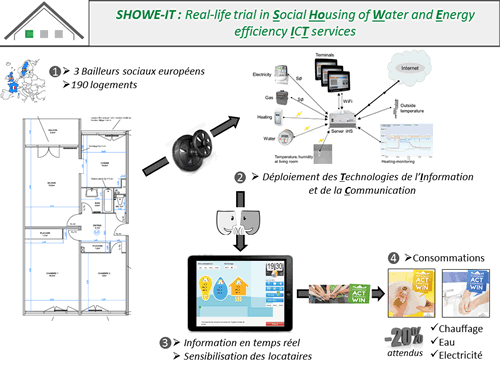
Real-life trial in Social Housing of Water and Energy efficiency ICT services
Type
European Project (funded under the European ICT-Policy Support Programme / ICT for energy efficiency and smart mobility)
Description
This project aims to implement water and energy consumption monitoring systems in 3 pilot buildings (England, France, and Sweden) to provide tenants with information on their consumption and raise awareness of water and energy saving practices. Our involvement will primarily focus on analyzing the results of collected measurements and evaluating the effectiveness of the monitoring and control system in terms of energy and environmental performance.
Project Manager
Jonathan Villot
Involved Collaborators
Natacha Gondran, Florent Breuil (Responsible Management and Innovation Department)
Coordination
Botkyrkabyggen AB (Swedish Social Housing Provider)
Duration
January 2011 – January 2014
Partners
Botkyrkabyggen AB (Swedish Social Housing Provider, coordinator), Rochdale Boroughwide Housing (Social Housing Provider, England), Cité Nouvelle, Siemens S.A.S., SMARVIS GmbH, Eca-Software GmbH, Acciona Infraestructuras S.A., GDF Suez, Aquagest Solutions, ARMINES, Bax & Willems, Söderenergi AB
Keywords
ICT, social landlords, energy sobriety, decision support
Intensification of the purification process for recycled cellulose fibers by ozone reactive flotation

Type
ANR (project funded under the 2010 edition of the “Ecotechnologies and Sustainable Development” Programme)
Description
Development of a new paper deinking process using ozone flotation and validation as best available technique. The role of the PIESO team in this project is to propose (i) a method for evaluating the performance of deinking processes with regard to BAT, and (ii) an evaluation of the OZOFLOT process
Project Manager
Valérie Laforest
Involved Collaborator
Jonathan Villot
Coordination
Grenoble INP-Pagora
Duration
January 2011 – January 2014
Partners
Laboratoire Génie des Procédés Papetiers (LGP2), Centre Technique du Papier (CTP), Kadant, Lamort, WEDEKO
Keywords
Deinking process, recycled paper, flotation, ozone, BAT, environmental assessment
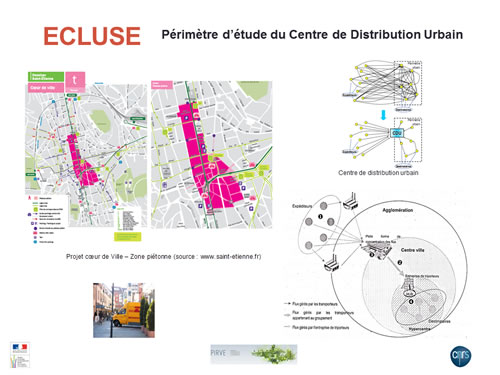
Study of urban logistics changes in the Saint-Étienne agglomeration
Type
Interdisciplinary Research Programme City and Environment (PIRVE – CNRS), 2011-2013.
Description
The objectives of the research project are to inform public decision-makers’ reflection on the evolution of urban logistics in Saint-Étienne, to capitalize on observations from field experiments, to analyze the interplay of actors leading to the structuring of urban logistics schemes, and to estimate the environmental, economic, and social impacts of new urban freight transport (UFT) modes.
Chef de projet
Patrick Burlat, École des Mines de Saint-Étienne / Institut H. Fayol / Département Génie de l’environnement et des organisations
Involved Collaborator
Nadine Dubruc
Other Collaborators
City of Saint-Étienne, Saint-Étienne Metropole, Epures, ESC Saint-Étienne, EIGSI (La Rochelle engineering school)
Service-Oriented Production Systems

Type
Regional funding (GOSPI cluster)
Description
Study of the impact of coupling service activities on the economy, organization, and working methods of industrial companies
Project Manager
Xavier Boucher
Involved Collaborators
Patrick Burlat, Marie-Agnès Girard, Lucien Vincent
Coordination
École des Mines de Saint-Étienne / Institut H. Fayol / Department of Environmental Engineering for Organizations
Duration
2010-2011
Partners
Laboratoire CO-ACTIS, UMR G-SCOP, Renault Truck, Michelin, Mécaloire
Keywords
Servitization, Functionality Economy, Product/Service Systems
Website: http://www.cluster-gospi.fr/
Sustainable Industrial Innovation through Servitization

Type
ANR
Description:
To study one of the current transitions of industrial companies towards the integration of service activities. The objective is to provide a company diagnostic approach as well as scientific knowledge on servitization, the economy of functionality, and on models intended to guide this strategic and organizational transition of companies.
Project Manager
Xavier Boucher
Involved Collaborators
Patrick Burlat, Marie-Agnès Girard, Natacha Gondran, Guillaume Marquès, Hervé Vaillant
Coordination
École des Mines de Saint-Étienne / Institut H. Fayol / Department of Environmental Engineering for Organizations
Duration
2012-2015
Partners
Laboratoire CO-ACTIS, UMR G-SCOP, UMR PACTE, MECALOIRE, ENVIE, SAVNetwork
Keywords
Servitization, Functionality Economy, Product/Service Systems, Re-industrialization, Sustainable Development
Systemic approach to risk analysis driven by the XRISK model
Type
UVED Funding
Description
The ASAR project, funded by UVED, aims to develop an open-source educational resource in the form of a case study (face-to-face and blended learning), allowing students to practice risk analysis methods contributing to the resilience of a system, and to design and make available a new educational tool for learning (face-to-face or blended learning) XRISK modeling and industrial risk analysis.
Project Manager
Alicja Tardy
Involved Collaborators
Éric Piatyszek, Clément Girard, Florent Breuil, Sophie Peillon, Axel Momm
Coordination
École des Mines de Saint-Étienne / Institut H. Fayol / Département Génie de l’environnement et des organisations
Duration
2012-01-15 – 2013-04-15
Partners
LINPG – G-SCOP
Keywords
Risk analysis, systemic modeling, XRisk, Risk analysis methodology
Research projects in collaboration with industrial partners or territorial organizations
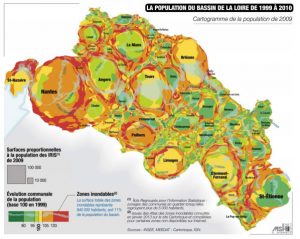
Awareness, Evaluation and Implementation of Flood Risk Prevention Tools, Application to the Loire basin
Type
Project linked to FEDER/Établissement Public Loire funding
Description
The proposed programme’s main objective is to produce relevant knowledge and effective responses regarding methods and tools aimed at reducing the vulnerability of urban systems to floods. This involves developing and offering managers methods and tools for the economic, industrial, and social assessment of vulnerability, as well as for evaluating the performance of PCS and the interactive use of DICRIM.
Project Manager
Eric Piatyszek
Involved Collaborators
Valérie Laforest, Alicja Tardy, C. El Hajj
Coordination
Université de Tours
Duration
March 2011 – November 2013
Partners
UMR 6173 CITERES, UMR ESPACE, UMR 5600, CEDETE
Keywords
Risk, vulnerability
Research projects in collaboration with industrial partners based on CIFRE theses
Decision Support Information System

Type
Doctorate, Michel Lutz. <NNT: 2013EMSE0688>
Description
Decision support for managing information system evolution scenarios.
Supervision
Xavier Boucher (Thesis Director), Marie-Agnès Girard, Olivier Roustand
Duration
2010-2013
Industrial Partner
STMicroelectronics
Keywords
Information system, Agility, Capacity Planning
Knowledge extraction for the decision support information system
Type
Doctorate, Hasna Yahyaoui. <NNT: 2015EMSE079
Description
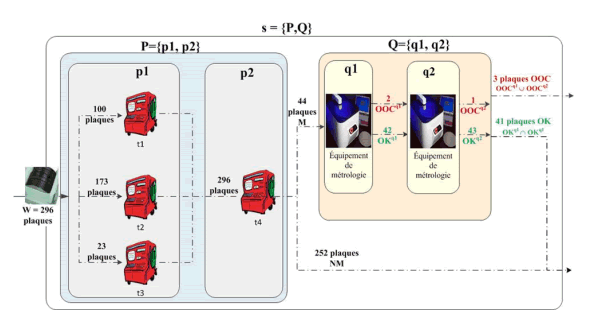
Ontology and data mining to improve the productive yield of a microelectronic manufacturing site.
Supervision
Xavier Boucher (Thesis Director), Philippe Beaune, Rodolphe Leriche, Marie-Agnès Girard
Duration
2012-2015
Industrial Partner
STMicroelectronics
Keywords
Information system, Ontologies, Data mining
Evaluation of CSR performance of actions carried out in the retail sector
Type
Doctorate, Sandrine Dumoulinneuf
Description
This thesis aims to evaluate the performance of actions implemented by a retail company with regard to its CSR objectives. The approach is based on an evaluation framework compatible with ISO 26000, which allows for identifying the most performing initiatives and proposing action plans to improve the company’s CSR performance, while taking into account its economic constraints.
Supervision
Patrick Burlat (Thesis Director), Natacha Gondran
Duration
2011-2013
Industrial Partner
Groupe Casino
Keywords
Evaluation, Performance, Corporate Social Responsibility, Action Plan, Retail (Distribution)
Research projects in the form of theses
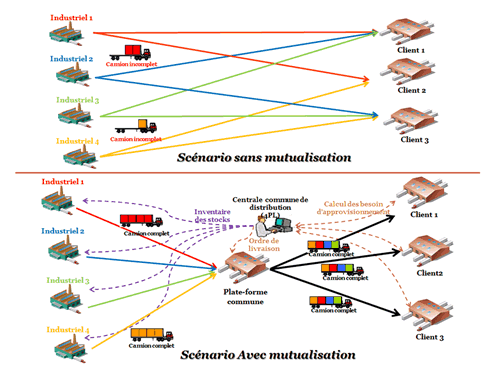
Pooling logistics flows to take into account the Sustainable Development objectives of agro-food SMEs.
Type
Doctorate, Regional funding, Abdelhamid Moutaoukil
Description
The objective of this research work is to propose organizational solutions allowing, with a view to sustainable development, the pooling of logistics flows for SMEs and SMIs in the agro-food sector of the Loire region. Based on an analysis of different pooling strategies and constraints related to the agro-food sector, the aim is to propose organizational scenarios, including companies and logistics providers, using simulation models.
Supervision
Patrick Burlat (Thesis Director), G. Neubert and R. Derrouiche (ESC St-Etienne)
Duration
2011-2014
Partners
ESC Saint-Étienne
Keywords
Logistics pooling; Horizontal collaboration; Sustainable Development, SMEs, Agro-food sector

Type
Doctorate, Regional funding, Malik-Eddine Chalal. <NNT: 2014EMSE0754>
Description
The objective of the thesis is to model and evaluate service-oriented production systems. Modeling is carried out by considering the specificities of the service-centric economic model in the case of manufacturing companies. The evaluation is performed to aid decision-making for companies wishing to transition to a service-based economic model. The evaluation is done from economic, environmental, and social perspectives. Decision support is based on two levers: on the one hand, capacity management (Human Resources) and on the other hand, contract management (Contract duration, Service quality, Service bundle). An analysis of the relationship between decisions in capacity management and contract management will be carried out.
Supervision
Xavier Boucher (Thesis Director), Marie-Agnès Girard, Guillaume Marquès
Duration
2010-2013
Partners
ENVIE Loire
Keywords
Simulation, Servitization, PSS.

Type
Doctorate, Mines School Grant, Lucile Faure. <NNT: 2015EMSE0803>
Description
This research aims to provide an ex-ante evaluation model for the various impacts (logistical, environmental, social, etc.) of an Urban Distribution Center (UDC). This model can then be integrated into a decision-support tool that would allow public or private decision-makers to test the effect of their choice to install this type of urban logistics space before making their decision.
Supervision
Patrick Burlat and Benoît Montreuil (Univ; Laval, Canada) (Thesis Directors), Guillaume Marquès
Duration
2012-2015
Partners
Université Laval (Canada)
Keywords
Urban logistics, Urban Distribution Center (UDC), ex-ante evaluation, decision support

Type
PhD, École des Mines scholarship, Carine El Hajj. <NNT: 2013EMSE0719>
Description
Development of a methodology for analyzing the risk of technological accidents induced by flooding (flood Natech). The final objective is to develop a decision-support tool (in the form of a questionnaire) intended for industrial stakeholders, enabling them to identify their vulnerability to flood Natech risk and to propose effective safety measures to reduce this risk.
Supervision
Valérie Laforest (Thesis Director), Eric Piatyszek
Duration
2010-2013
Keywords
Flood Natech, hazardous substances, loss of containment, bow-tie nodes, hazardous phenomena.