
The Department of Mathematical and Industrial Engineering (GMI) conducts applied research projects aimed at optimizing decision-making, modeling complex systems, and analyzing industrial data. This section presents a selection of past projects that contributed to the development of innovative methods in optimization, simulation, and artificial intelligence applied to industrial and territorial systems.

To increase the efficiency of simulation-based industrial processes, uncertainty quantification and numerical optimization steps must be improved. Such issues arise in most engineering fields (e.g., energy, transport, agriculture) and scientific domains (e.g., biology, physics). A major challenge stems from the “black-box” nature of the process of interest, which is often not directly accessible: in general, the only information available is the output of the “black-box” simulation. In particular, derivative information, which is highly valuable in the context of optimization and uncertainty quantification, is not available. This situation is a direct consequence of the growing complexity and diversity of industrial problems to be addressed (e.g., coupling multi-physics or multidisciplinary simulators, economic models, more sophisticated learning models, integration of uncertain or non-Euclidean variables). Solving this problem is therefore a major challenge with direct and significant industrial impact.
The project’s main objectives are, jointly, to develop innovative simulation and optimization methods based on surrogate models, while pushing the current limits of their performance and applicability, guided by real-world applications. These applications relate to the design and risk assessment of complex systems.
Dates
- 2021-01-01 – 2024-12-31
Partners
- CEA DER – Reactor Studies Department / French Alternative Energies and Atomic Energy Commission
- SAFRAN
- Polytechnique Montréal / Department of Mathematics and Industrial Engineering
- IFPEN – IFP Energies nouvelles
- EDF SA – EDF RD SITE CHATOU
- L2S Laboratory of Signals and Systems
Contacts
- Project Lead
Rodolphe Le Riche
Mines Saint-Étienne, LIMOS, CNRS
Email: leriche@mines-stetienne.fr
- Participant
- Babacar Sow
Keywords or themes
Industry, applied mathematics, optimization, uncertainty, expensive data
Sustainable Development Goal
Publications
- This presentation explores innovative methods for the optimization and metamodeling of complex functions defined over sets of vectors (or "clouds of points"), with various applications such as wind-farm layout or experimental design optimization. Unlike more common functions defined over vectors, functions defined over sets vectors have the specificity of being invariant with respect to the […]
- This paper introduces an evolutionary algorithm for objective functions defined over clouds of points of varying sizes. Such design variables are modeled as uniform discrete measures with finite support and the crossover and mutation operators of the algorithm are defined using the Wasserstein barycenter. We prove that the Wasserstein-based crossover has a contracting property in […]
- Nous consid´erons l’optimisation de fonctions d´efinies sur des ensembles de vecteurs (ou nuages de points). Classiquement, ces fonctions ´etant coˆuteuses, elles sont partiellement remplac´ees par des m´etamod`eles. La variable de d´ecision porte sur un ensemble de vecteurs et a des tailles variables dans un ensemble fini des entiers naturels. Un noyau semi-d´efinipositif sur les nuages […]
- We consider the optimization of functions where the variables are clouds of points (equivalently bags of vectors). The clouds can have different sizes and the objective functions are invariant under arbitrary permutation of the points within the cloud. Furthermore, no information related to the convexity and/or smoothness of the functions is available. Such functions are […]
- […]
- We consider the problem of optimizing black-box functions having sets of points as inputs (also referred to as clouds of points). Functions defined over sets are of common practical use and can be encountered when modeling turbine positions in wind farms, designs of experiments and designs of sensors or actuators networks, among others. In this […]
- We consider the task of estimating functions from a restricted number of observations where the inputs are in the form of varying-size sets of vectors. A classical method in this expensive functions context is to approximate the true expensive function with a Gaussian process that relies on semi-definite positive kernels. Varying-size sets of vectors have […]
- […]
News
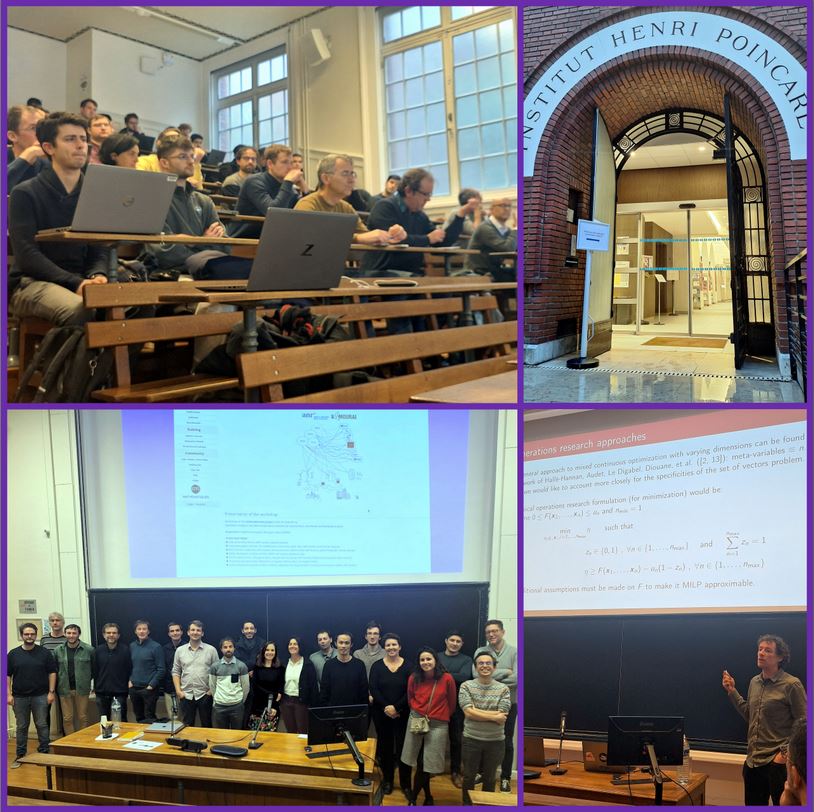
- Le projet ANR SAMOURAI (Simulation Analytics and Meta-model-based solutions for Optimization, Uncertainty and Reliability AnalysIs) a officiellement pris fin en décembre 2024 avec la tenue de son workshop final à l’Institut Henri Poincaré, à Paris. Cette rencontre a marqué une … Lire la Suite →
Structuring Project for Competitiveness (PSPC)

The objective of the project is to accelerate the digitalization of production workshops, particularly those of small structures, through several major technological innovations (software, electronics, and Telecom innovations). For this project, complementary stakeholders—from IIoT to software—have grouped together to develop a solution with a common goal of making it “simple” and adapted to SMEs. The aim is to develop an innovative solution (hardware, software, service) that is simple to use and will significantly accelerate the digital transformation of medium-sized industrial workshops (manufacturing and packaging workshops) by: (1) Reducing implementation and infrastructure costs (autonomy and simplicity of access to technology), (2) Reducing operating costs (Solution As A Service rather than investment), (3) Reducing electricity consumption (shared infrastructure). A global Solution As A Service (100% cloud MES software and hybrid 5G IIoT hardware representing a technological breakthrough), EASY SMART FACTORY will allow a workshop to be digitalized quickly and independently. Depending on their needs, the manufacturer will configure the different blocks of their solution on an e-shop and then receive the hardware. With the software interfaced with the ERP, they will have all the real-time data from their workshop to share with their teams to improve competitiveness.
Project manager
- Astrée Software
Contributing collaborators: Damien Lamy, Xavier Delorme, Frédéric Grimaud
Duration
- 2021-2023
Partners
- Astrée Software
- LIMOS
- Eurécom
- Editag.
Type
European project
Description
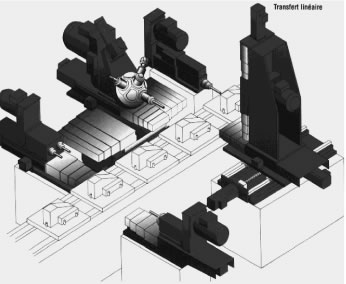
Development of a product and process engineering platform based on the most recent research in semantics, metaheuristics, and visualization.
Project manager
Fraunhofer-Gesellschaft – Institute for Industrial Engineering IAO (Joachim Lentes)
Contributing collaborators
- Olga Battaia, Alexandre Dolgui, Frédéric Grimaud, Xavier Delorme.
Duration
- 2011-2013
Partners
Fraunhofer-Gesellschaft – Institute for Industrial Engineering IAO, Politecnico di Torino, Univ. of Limerick, Univ. of Nottingham, Università degli Studi di Trieste, Ontoprise GmbH, Intel, RTT Romania, Aerogen LTD, MBtech Group GmbH, Shannon Coiled Springs Ltd.
Type: collaborative project funded by the ANR
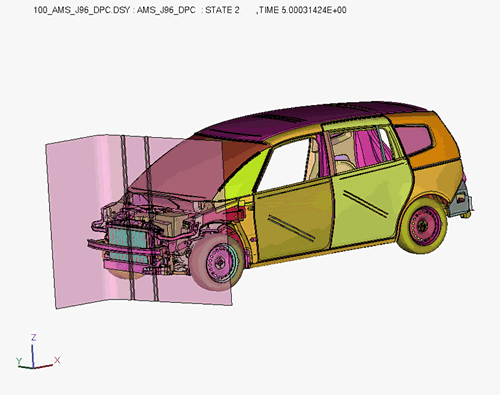
Description: development of methods to use multi-disciplinary, multi-scale numerical simulations in the optimal design of complex objects such as cars and aircraft.
Project lead: Renault
Contributing collaborators: Rodolphe Le Riche, Xavier Bay, Eric Touboul, Ramunas Girdziusas, Janis Janusevskis.
Duration: 2009–2012
Partners: INRIA, Renault, Sirehna, Activeon, Université de Technologie de Compiègne, LMT Cachan, Scilab.
Type: industrial collaboration project
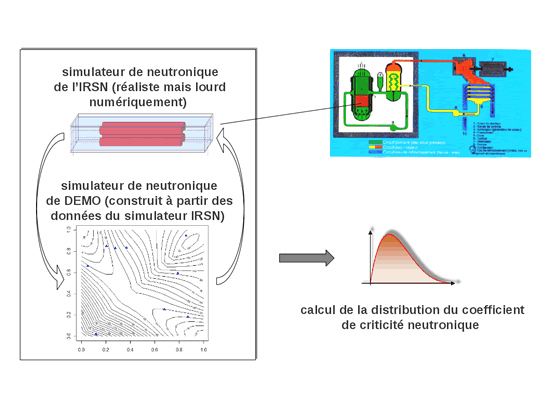
Description: development of new methods for the exploration and optimization of large computational codes (“computer experiments”).
Project lead: University of Bern
Contributing collaborators: Olivier Roustant, Mireille Batton-Hubert.
Duration: 2011–2014
Partners: IRSN, Renault, CEA, IFP Energies Nouvelles (IFPEN), Électricité de France (EDF), Université Pierre-Mendès-France (Grenoble), Université Jean Monnet / Telecom (Saint-Étienne).
Type: ANR project
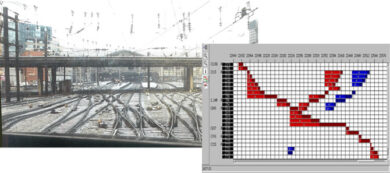
Description: implementation of indicators and development of optimization methods to design railway timetables that are robust to disruptions.
Project lead: Mines Saint-Étienne – GMI Department (Xavier Delorme).
Contributing collaborators: Xavier Delorme, Frédéric Grimaud, Alexandre Dolgui.
Duration: 2012–2015
Partners: SNCF, Centre de microélectronique de Provence de l’Ecole des Mines de Saint-Étienne
Type: European collaborative project
Description: CO-DESNET (COllaborative DEmand and Supply NETworks) aims to use “Network Re-Engineering” (NRE) tools to reorganize services within SME networks.
Project lead: Politecnico di Torino – DSPEA (Italy).
Contributing collaborators: Alexandre Dolgui, Hélène Marian, Frédéric Grimaud, Xavier Delorme, Olga Battaia.
Duration: 2008–2012
Partners: Nottingham University (UK); Linkoping Universitet (Sweden); LAAS Toulouse (France); Universitat Stuttgart (Germany); Università Roma Tre (Italy); IASI – CNR, Roma (Italy); Università di Trieste (Italy); Università di Palermo (Italy); KARMAN S.p.A., Torino (Italy); University of Limerik (Ireland); University of Patras (Greece); Hungarian Academy of Sciences – MTA SZTAKI, Budapest (Hungary); Tel Aviv University (Israel); Politechnica Wroclawska, Wroclaw (Poland); BIKIT, Ghent (Belgium); THESIA S.p.A:, Milano (Italy); Supply Network Shannon, Limerik (Ireland); CIRP GmbH, Leonberg (Germany); EIDON S.p.A., Udine (Italy); Institute of Logistics and Warehousing, Poznan (Poland).