The governance of Mines Saint-Étienne is structured to support our mission as a driving force for innovations with societal impact. It is based on a democratic and collegial framework, ensuring transparency, collaboration, and efficiency.
Major decisions are made in consultation with the School Council, a deliberative body representing various stakeholders, including faculty, staff, students, and industrial and academic partners. This council defines the school’s strategic direction and ensures coherence in its policies and initiatives.
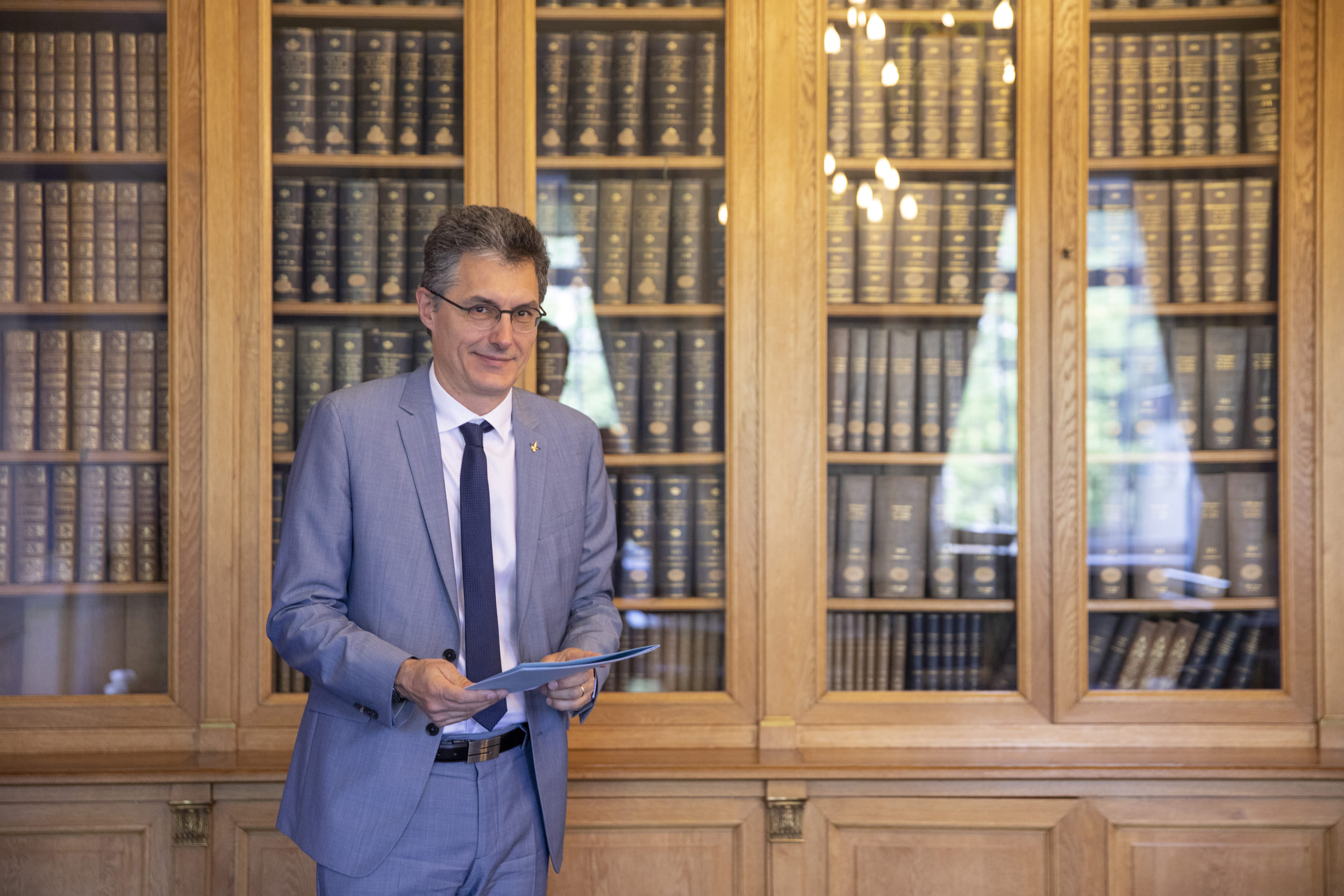
Jacques Fayolle, Director of the School, in the Council Room.
The school is led by a Director, appointed by the Ministry of Economy and Finance, who oversees the global strategywith the support of the executive team. This team includes two Deputy Directors, functional directors, and heads of research and education centres.
To ensure participatory governance, Mines Saint-Étienne also relies on several thematic committees (research, education, sustainable development, and social and environmental responsibility). These committees ensure that all stakeholders’ voices are heard, fostering innovation and practical solutions to societal challenges.
Mines Saint-Étienne is a member of Institut Mines-Télécom (IMT), a major player in higher education and research in France. IMT brings together several top engineering and management schools, supporting economic, industrial, and societal transitions through an innovative and collaborative approach. This affiliation provides access to a national and international network of academic and industrial partners, reinforcing the school’s mission in education and research for the benefit of society.
School Council
The School Council is established in accordance with Decree No. 2012-279 (amended) of 28 February 2012 relating to Institut Mines-Télécom, and the Order of 5 December 2016 concerning École nationale supérieure des mines de Saint-Étienne.
These members are selected for their expertise in education, science, technology, economics, and industry. They are appointed by the Chair of the Board of Directors of Institut Mines-Télécom, following the board’s approval.
Selected in consultation with alumni associations, this representative is appointed by the Chair of the Board of Directors of Institut Mines-Télécom, following the board’s approval.
Stéphane MANGIAVACCA – President of the Alumni Association
Appointed by joint decision of the Minister of Industry and the Minister of Electronic Communications, ensuring gender balance.
Five Representatives of the State
On behalf of the Minister of Industry:
Nomination pending Substitute: Élodie Conan, Head of the Strategic Sectors and Innovation Unit, at the Regional Directorate for the Economy, Employment, Labour and Solidarity (DREETS) Auvergne-Rhône-Alpes
On behalf of the Minister of Electronic Communications:
Philippe Laval, Head of the Schools Supervisory Mission at the CGEIET Alternate: Hélène Le Du, Deputy Head of the Schools Supervisory Mission at the CGEIET
On the proposal of the Minister of Higher Education:
Angélique DIAZ, Chief of Staff to the Rector’s Delegate for Higher Education, Research and Innovation for the Auvergne-Rhône-Alpes Academic Region
On the proposal of the Minister of Research:
Béatrice Burdin – Deputy Regional Delegate for Research and Innovation in the Auvergne-Rhône-Alpes Region
On the proposal of the Minister of Budget:
Sandrine Chalaye-Levy, Senior Inspector of Public Finances at the Loire Departmental Directorate of Public Finances Substitute: Ludovic Stheme de Jubecourt, Divisional Inspector of Public Finances at the Loire Departmental Directorate of Public Finances
Three Representatives of Local Authorities or Their Groups (Appointed on the proposal of their executive bodies)
Representative of the Auvergne-Rhône-Alpes Regional Council:
Aline Mouseghian Alternate: Laurence Bussiere
Representative of the Provence-Alpes-Côte d’Azur Regional Council:
Patricia Colin Deputy: Suzelle Ayot
Representative of Saint-Étienne Métropole:
Christophe Faverjon, Vice President of Saint-Étienne Métropole in charge of higher education Substitute: Charles Dallara
Pour offrir les meilleures expériences, nous utilisons des technologies telles que les cookies pour stocker et/ou accéder aux informations des appareils. Le fait de consentir à ces technologies nous permettra de traiter des données telles que le comportement de navigation ou les ID uniques sur ce site. Le fait de ne pas consentir ou de retirer son consentement peut avoir un effet négatif sur certaines caractéristiques et fonctions.
Fonctionnel
Always active
Le stockage ou l’accès technique est strictement nécessaire dans la finalité d’intérêt légitime de permettre l’utilisation d’un service spécifique explicitement demandé par l’abonné ou l’utilisateur, ou dans le seul but d’effectuer la transmission d’une communication sur un réseau de communications électroniques.
Préférences
Le stockage ou l’accès technique est nécessaire dans la finalité d’intérêt légitime de stocker des préférences qui ne sont pas demandées par l’abonné ou l’utilisateur.
Statistiques
Le stockage ou l’accès technique qui est utilisé exclusivement à des fins statistiques.Le stockage ou l’accès technique qui est utilisé exclusivement dans des finalités statistiques anonymes. En l’absence d’une assignation à comparaître, d’une conformité volontaire de la part de votre fournisseur d’accès à internet ou d’enregistrements supplémentaires provenant d’une tierce partie, les informations stockées ou extraites à cette seule fin ne peuvent généralement pas être utilisées pour vous identifier.
Marketing
Le stockage ou l’accès technique est nécessaire pour créer des profils d’utilisateurs afin d’envoyer des publicités, ou pour suivre l’utilisateur sur un site web ou sur plusieurs sites web ayant des finalités marketing similaires.