
Addressing the structural shortcomings of generative AI models when faced with the rigour of the judicial world is the challenge taken up by two Mines Saint-Étienne Alumni in creating Talia. This specialised AI assists lawyers by providing sourced, verifiable answers grounded in French law. They attended the Vivatech trade show in Paris to present their solution, as well as the International Conference on Machine Learning (ICML) in Seoul.
Complex, technical and rigorous, the law cannot settle for approximation. It requires a level of precision that general-purpose AI systems structurally cannot achieve, as Daniel Guez explains: “We interviewed 58 lawyers to understand their needs. The message is clear: without verifiable sources, without specialisation by field, a legal AI has no value”.
It was therefore to fill this gap that he created Talia with Rose Gymbler. Incubated at Mines Saint-Étienne, their start-up stands out for:
- its reliability, with 100% traceable statements;
- its relevance, based on expert knowledge of French law;
- its transparency: confidentiality, GDPR compliance, sovereignty.
A disruptive software architecture
Talia combines the power of large language models with a strict verification architecture. Its model is based on a multi-agent system, capable of segmenting reasoning and cross-referencing different areas of law (tax, criminal, consumer, etc.) to determine the most relevant case law.
To achieve this level of accuracy, the solution is based on complete mastery of legal language and the judicial semantic field. It then searches for the exact version of the applicable law in official sources.
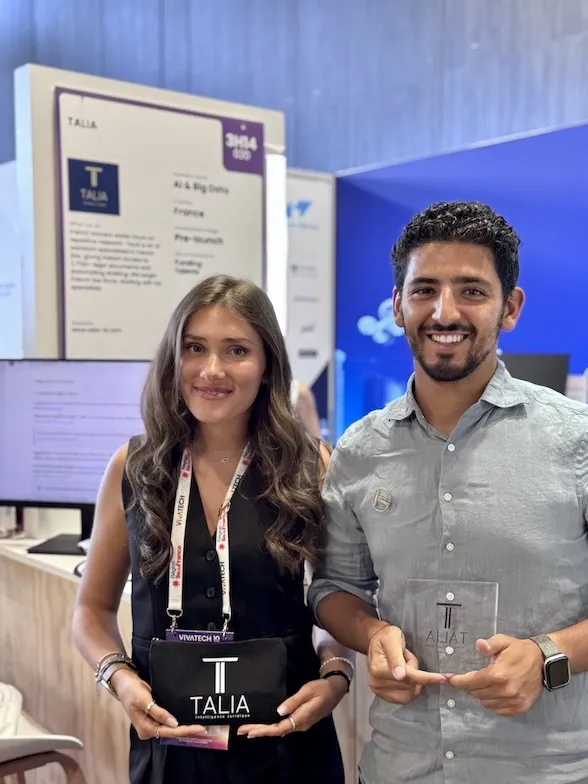
With Talia, Rose Gymbler and Daniel Guez illustrate the ability of Mines Saint-Étienne Alumni to put technological innovation at the service of reliable, responsible solutions tailored to society’s challenges.