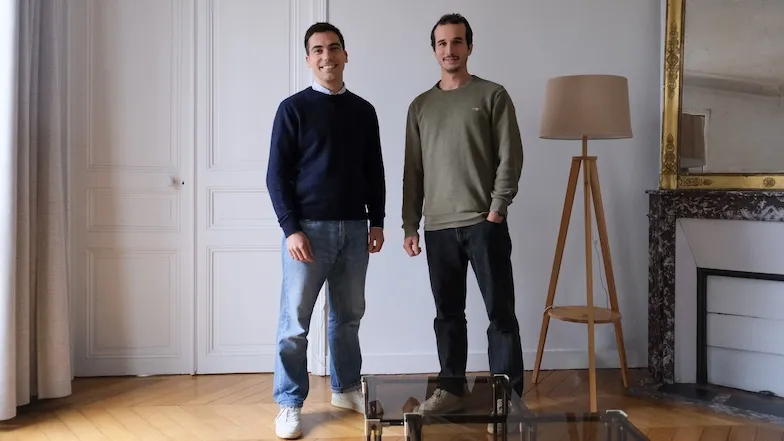
Paul Bonnet-Eymard and Thibaut Cassard both followed the Ingénieur Civil des Mines (ICM) curriculum – class of 2016. They have just created a very short-term weather forecasting tool, the results of which can have a strategic impact in many professional sectors.
After leaving the lecture halls of Mines Saint-Étienne, the two young engineers embarked on two distinct professional paths. Thibaut has been a data scientist specializing in meteorology for six years. He first worked at Plume Labs (a company specializing in air quality), then at AccuWeather, where he designed forecasting models (air quality, lightning, rain) currently used by millions of users.
Paul, for his part, spent five years at Air Liquide, notably in marketing, business development, and the design of industrial B2B offers.
They recently combined their expertise to found Odeai, a company that designs weather forecasting models with a 3-hour horizon, updated every ten minutes. The two alumni took part in a Q&A session to share their experience with us.
How does Odeai work, and what service does your solution provide?
Odeai develops very short-term weather forecasting models. Our approach consists of starting directly from observations (radars, satellites) and mastering the entire chain ourselves, from raw data to the forecast, by combining physics and artificial intelligence.
This approach limits successive approximations and allows forecasts to be refreshed in a few minutes, with very high accuracy at short notice.
We started with rain forecasting, with several sectors already identified: viticulture, major sporting events, civil protection, and water network management.
Eventually, we will cover more variables (wind, sunshine) over longer horizons, with the energy sector in our sights, where players have a strong need to forecast tomorrow’s production today.
What motivated your project?
Weather, even in the very short term, dictates very concrete decisions: in viticulture, for example, a treatment against downy mildew, washed away by a shower, must be redone, at an economic and environmental cost. For a sporting event or crisis management, being a few dozen minutes ahead can change everything.
Current tools do not meet this need for visibility over the coming hours: the traditional chain loses information and time even before producing a forecast. Our combined experience in weather forecasting (Thibaut) and business development (Paul) made us want to build the answer ourselves.
Odeai is available in the United States… Soon in Europe?
Yes: Odeai will be launched in France, and more broadly in Europe, by the end of the year. As mentioned, we will then add other phenomena (lightning, hail, wind, sunshine) and also plan to gradually extend the forecasting horizon, from 3 hours today to 12 or even 24 hours by the end of 2027.
What did your time at Mines Saint-Étienne bring to you?
We both followed the Ingénieur Civil des Mines (ICM) curriculum, class of 2016. The School provided us with a solid scientific and technical culture, but also true versatility: knowing how to move from one subject to another, work in a team, and understand both technical and industrial challenges.
It is this combination that serves us today, one on the forecasting models side, the other on the business development side.
What advice would you give to today’s engineering students?
We still feel like “young graduates,” so rather than advice, perhaps two convictions. First, AI tools today multiply the ability to develop technical ideas: you can prototype in a few days what used to take months.
Secondly, in return, they require having clear ideas about the problem to be solved before starting, because a powerful tool applied to a poorly formulated question mostly makes you lose time faster.
A small anecdote to illustrate this: at Odeai, we very often work on paper first before using an LLM1. Putting things down by hand forces you to understand before producing, and this is a reflex we have kept from our background and training.
Paul and Thibaut’s experience illustrates the commitment of Mines Saint-Étienne to training engineers capable of designing concrete solutions in line with industrial and socio-economic issues.
- “Large Language Model”: Generative text AI ↩︎