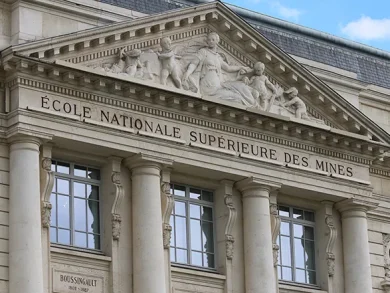
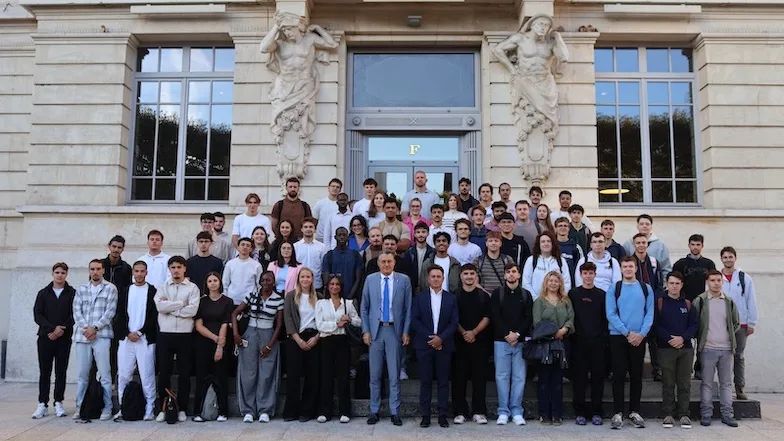
This year, nearly 370 new students have chosen a work-study engineering program at Mines Saint-Étienne. Offered in partnership with ISTP, these programs combine academic contributions and immersion in companies. The four specializations began their academic year, on a staggered basis, at the historic campus located at 158, cours Fauriel.
As a complementary path to becoming an engineer, work-study programs provide solid field experience, guaranteeing rapid professional integration.
Each of the four specializations leads to an engineering degree accredited by the Commission des titres d’ingénieurs (CTI). Students alternate between school and company throughout their program, either as apprentices or employees, and benefit from personalized support from both sides.
Nuclear Engineering Engineer
The academic year started on September 14, with students from the Nuclear Engineering program. Offered in agreement with the National Institute for Nuclear Science and Technology (INSTN), this program opens up professional prospects at the heart of energy, industrial, and environmental challenges.
It trains engineers capable of intervening across the entire lifecycle of nuclear facilities, whether civilian or military:
- Design
- Construction
- Operation
- Maintenance
- Decommissioning
- Waste Management
- Safety
This degree provides rare and sought-after expertise in the context of energy transition, where low-carbon electricity production plays a central role.
Energy Engineering Specialization
The new cohort of the Energy Engineering specialization program began its academic year on September 21. Rooted in the challenges of energy and ecological transition, this program prepares future engineers to analyze, optimize, and transform energy systems.
They will thus be led to propose technical solutions adapted to the industrial and tertiary sectors, and to manage short- and long-term energy efficiency projects.
Upon graduation, Energy Engineering students will possess crucial expertise to address strategic challenges such as decarbonization, consumption optimization, and the development of renewable energies.
Embedded Electronic Systems Engineering
On October 9, it was the turn of the Embedded Electronic Systems Engineering program to resume. Focused on intelligent technologies, this program leads engineering students to design solutions that combine electronic architecture, software development, and system engineering.
It allows them to acquire a set of essential skills to build a global vision and develop autonomous and reliable systems:
- Embedded Electronics
- Real-time Computing
- System Design and Integration
- Security and Communication
Industrial Engineering Engineer
This series of academic year starts concluded on October 15, with the Industrial Engineering program, which focuses on versatility. This degree highlights the diverse missions of these future engineers. Key players in industrial performance, these future engineers will be able to manage production activities, optimize supply chains, ensure operational excellence, or lead innovation projects.
The degree offers numerous career opportunities in very diverse sectors of activity:
- Energy
- Aeronautics
- Automotive
- Defense
- Food Industry
- Electronics
- Industrial services
Beyond their diversity, Mines Saint-Étienne’s work-study engineering programs share a common foundation: the ambition to support major industrial transitions by valuing expert, transversal, and innovation-driving knowledge.