
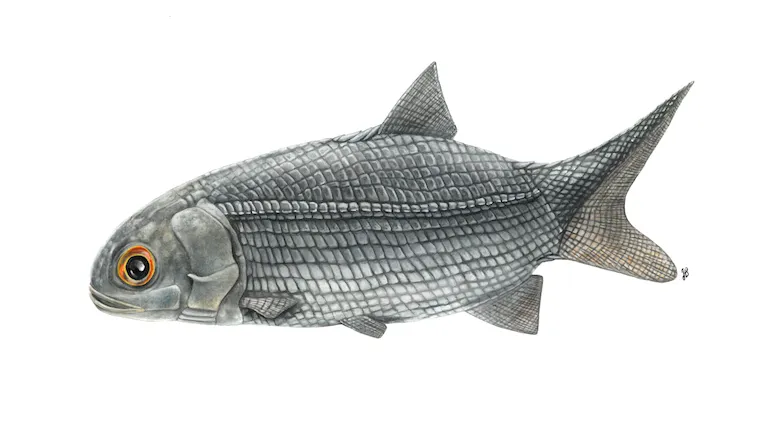
It is 300 million years old and has just been identified at Mines Saint-Étienne from a forgotten sample… Named Stephaniella melanocephala, this lacustrine fish of a previously unknown species provides new insights into the evolution of life. It also highlights the richness of the School’s geological collections, which may well contain other treasures!
Stephaniella melanocephala belongs to the Aeduellidae family: freshwater fish with comb-shaped teeth that fed on small invertebrates. It measured approximately 15 cm as an adult, and was contemporary with other extinct animals, such as the giant dragonfly Meganeura.
This was 300 million years ago, and the Saint-Étienne basin then resembled a vast area of lakes and swamps surrounded by primary forest and overlooked by high mountains.
As the first vertebrate described in detail in this basin, Stephaniella melanocephala provides new information on the anatomy of an ancient lacustrine fish. It also helps us better understand the evolution of different species from that era.
An unexpected discovery
It took a series of coincidences for Stephaniella melanocephala to come to light! From surveys conducted in the 1950s to 1970s, the fossil awaited its moment in a storage area, among hundreds of other samples.
Michel Pouzadoux, the referent in charge of inventories, brought it out of obscurity as part of the renewed census of these “forgotten collections.” A meticulous task that requires studying and categorizing tens of thousands of pieces…
These samples, once threatened with disappearance, are generating interest as the inventory progresses: « I found beautiful fauna fossils, which had been totally neglected in favor of flora for the study of the biostratigraphy of coal deposits. This fish caught my attention, but the rest of the story surpassed anything I could have imagined! »
Michel Pouzadoux decided to seek the expertise of Daniel Gonçalves, a paleontology student at the University of Toulouse, specializing in Carboniferous fish. And through the analyses, the specimen gradually revealed anatomical elements of a previously unknown species.
Named Stephaniella melanocephala, it was finally the subject of an official publication in the international scientific journal Zoological Journal of the Linnean Society (June 2026), with the support of Vincent Luccisano, paleontologist at the Paris Paleontology Research Center (CR2P), CNRS, MNHN, SU.
For Ségolène Courant, head of collections at Mines Saint-Étienne, « this is an extraordinary discovery, which brings new recognition to the collections and contributes to the School’s influence ».
More than a third of the fossils in the Mines Saint-Étienne collections still need to be analyzed. We can only hope for new findings, especially since the preliminary examination of numerous samples has already shown that a diverse paleofauna remains to be studied: mollusks, bivalves, crustaceans, insects… undoubtedly with other pleasant surprises in store.