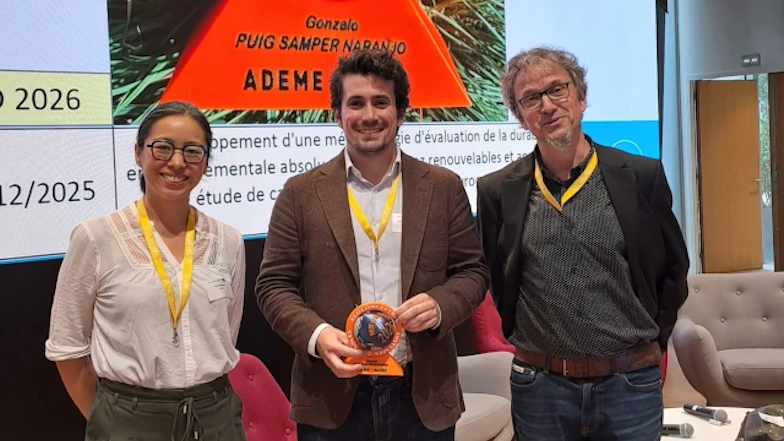
Gonzalo Puig-Samper has been awarded by EcoSD and ADEME for his PhD dissertation on environmental sustainability. This is wonderful recognition for this young researcher, an ICM graduate, whose work delivers a powerful message about the environmental impact of our lifestyles.
How can the environmental unsustainability of our production and consumption patterns be demonstrated? This critical issue for the future of our societies lies at the heart of the research conducted by Gonzalo Puig-Samper.
Passionate about the environment, he decided to pursue research after earning his engineering degree in 2020. He then joined the Joint Research Unit UMR 5600 “Environnement Ville Société” at Mines Saint-Étienne and began a PhD thesis focusing on planetary boundaries under the supervision of Natacha Gondran.
Gonzalo defended his doctoral thesis, “Methodological advances towards an absolute environmental sustainability assessment: application to energy systems”, in December 2025.
Winner of the 2026 EcoSD/ADEME PhD Award
Gonzalo’s doctoral research proposes complex, rigorous quantitative methodological developments. It reflects a profound ethical commitment and the determination to demonstrate the imperative of making our activities sustainable.
The relevance and impact of his research earned Gonzalo the 2026 PhD Award in sustainable systems ecodesign, presented by EcoSD—the foremost network of researchers and engineers in sustainable systems ecodesign in France—and ADEME, the French Agency for Ecological Transition.
This accolade provides additional visibility to Gonzalo’s research, who took part in a Q&A session about his work.
What does this award mean to you?
First and foremost, this award highlights research on absolute environmental assessment, in a context where these topics are not always given sufficient attention. The fact that ADEME co-organizes this award underscores the importance of these issues for decision-making and public policy.
It is also recognition of the work I have carried out over recent years. It rewards the effort invested in this dissertation, as well as the guidance of my thesis supervisors, who helped me structure and successfully bring this project to fruition.
I carried out this PhD research at ENGIE’s CRIGEN lab, funded by the ANRT (French National Association for Research and Technology),and within the Mines Saint-Étienne branch of the UMR 5600 “Environnement Ville Société”.
Could you briefly outline your thesis?
My dissertation focuses on methods for absolute environmental sustainability assessment. In other words, it seeks to determine how to assess the environmental impacts of countries, economic sectors, or products against the limits imposed by nature.
It puts forward methods to quantify the uncertainties inherent in these evaluations, presents an approach to integrating environmental limits related to biotic resources, and develops a framework to assess public policy scenarios in relation to planetary boundaries and human well-being.
What led you to choose this topic?
I have always been passionate about the environment and, more specifically, the interactions between human systems and nature. This research topic was ideal for exploring these dynamics and understanding the transformations required for us to continue living sustainably on the planet.
Your work highlights the environmental unsustainability of our production and consumption patterns: what impact could this have on our daily lives?
The consequences for our daily lives could be significant if we take the scientific community’s findings seriously. Notably, my dissertation demonstrates that technological solutions, which reduce environmental impacts per unit produced, are not sufficient on their own to respect planetary boundaries.
It is therefore crucial to support these advances with sufficiency policies aimed at curbing overall demand for goods and services, particularly non-essential ones. A fairer distribution of this demand is also essential to grant everyone access to a decent standard of living while staying within environmental boundaries.
What are the areas of application for your research (industry, public stakeholders, etc.)?
My research can be applied by a broad range of public and private stakeholders seeking to evaluate their environmental footprints and establish strategies consistent with planetary boundaries. During my PhD, I specifically applied these methodologies to an industrial energy sector and to carbon neutrality scenarios for France. This demonstrates that the application areas for these methods are remarkably diverse.
What are your future plans?
I would like to pursue an academic research career in these fields, with a particular focus on methodological challenges. I am currently continuing my scientific career at the Luxembourg Institute of Science and Technology, where I investigate the assessment of transition policies across various sectors, including urban transport, construction, and energy.
Our thanks to Gonzalo Puig-Samper for his research, which reflects Mines Saint-Étienne’s commitment to supporting major transitions tied to global environmental challenges.