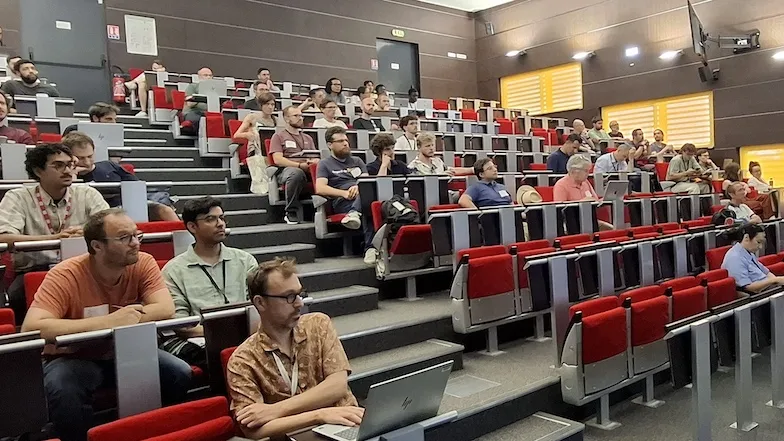
The EC-SAS Doctoral Students’ Day took place on June 22 at the Centre of Microelectronics in Provence. During this event, the CEA–Mines Saint-Étienne team presented its work in hardware security, before exchanging with thesis supervisors and industry representatives.
This edition of the Doctoral Students’ Day brought together 57 participants around the work of doctoral students in their 1st and 2nd years. Each participant was able to present their research to an audience made up of thesis supervisors from numerous laboratories:
- CEA
- SAS – Secure Systems and Architectures (Centre of Microelectronics in Provence), Mines Saint-Étienne
- Henri Fayol Institute, Mines Saint-Étienne
- TSP – Télécom SudParis
- LCIS – Laboratory for the Design and Integration of Systems, Université Grenoble Alpes
- IETR – Institute of Electronics and Digital Technologies, University of Rennes
- ANSSI – French National Agency for the Security of Information Systems
Many industry partners were also present, including Thales, STMicroelectronics, Alphanov, SealSQ and Cryptoquantique. They were able to appreciate the researchers’ work and discuss the proposed security solutions.
Innovative projects in microelectronics security
Sixteen students presented their work during the day:
- Éléa Robert — Validation of an attacker model for laser attacks on integrated circuits.
- Mohamdi Embuitu Boulsane — Acoustics and electromagnetism (AEM): new approaches for the security-oriented hardware characterization of components.
- Tom Voitzwinkler — Evaluation of PMNS for Dilithium: performance overhead and resilience to side-channel attacks.
- Assaad Alsaneh — Security of large AI models during post-training and deployment phases.
- Martin Lacaille — Local embedded blockchain on secure physical devices.
- Apollinaire Criquet — Laser attack techniques applied to the reverse engineering of memories.
- Larissa Santana De Freitas Andrade — Design and experimental investigation of optoacoustic interactions in CMOS circuits.
- Mouhameth Yate — Integration of MRAM technologies to design resilience mechanisms against hardware faults on a RISC-V processor.
- Soline Casavecchia — Laser fault injection: a new approach for attacks on CPU and cache.
- Hugo Perrin — Simulation and modelling of the effects of laser-based thermal stimulation of integrated circuits.
- Virgile Bouchon — Use of a CCFI security scheme to observe and model the effects of EMFI on a RISC-V core.
- Benjamin Hubinet — Security by design for neural networks embedded on a RISC-V platform.
- Thomas Ravelet — PEM-assisted laser fault injection on an 8 nm FinFET SoC.
- Nascimo Madieta — Efficient implementations of post-quantum cryptographic algorithms that are resistant to physical attacks.
- Axel Guichaoua — Evaluation of BBICS effectiveness in monitoring Triple-Well logic and picosecond-order LFI.
- Victor Gerenton — Security and vulnerability of passive optical access networks in a side-channel attack context.
These research topics conducted on the Aix-Marseille-Provence campus illustrate Mines Saint-Étienne’s commitment to addressing major technological and societal challenges.