Co-founder and CEO of EDITAG since 2007, president of Les Entrepreneuriales in PACA, Frédéric Pithoud will be the patron of future engineers trained at Campus G Charpak Provence. He has collaborated with our School for several years through various educational and professional activities.
A general engineer by training (HEI), passionate about industry and innovation, Frédéric Pithoud focused his career on production management, industrial organization, and optimization long before the expansion of “Lean.” He looks back with us on his career, shares his vision of the engineering profession, and places (or re-places) the human element at the heart of corporate performance.
What is your professional background?
After an initial experience as a product manager in an SME, I worked in Switzerland as a consultant on industrial organization optimization projects and IT solution deployments, primarily in the micromechanics and watchmaking sectors.
I then joined ST Microelectronics, in Grenoble, the United States, and then Rousset (13), for missions involving production management, deployment of factory control solutions, management of subcontracting activities, and supply-chain improvement across all factories worldwide, particularly in Asia, an activity I led for 12 years.
In 2007, I founded Editag, an innovative company dedicated to manufacturing IoT solutions for the manufacturing industry, now engaged in international deployment.
Located in Meyreuil (13), it has 20 employees, and 5 recruitments are currently underway.
What are your ties with the Georges Charpak Provence Campus?
Editag has hosted several work-study students from the School and regularly hosts ISMIN students for internships. We are involved in the ISMIN programme through industrial projects, Innov’actions, and Les Entrepreneuriales: students are engaged in this initiative from the first year of the curriculum.
Innovative collaborative projects are conducted with the campus teams and will lead to thesis topics. Our collaboration is growing!
We are also very present in the regional ecosystem alongside Mines Saint-Étienne on topics such as microelectronics technologies, the Internet of Things, and digital security… as an involved member of the SCS global competitiveness cluster (Secure Communicating Solutions) or ARCSIS, the former association for Research on Secure Integrated Components and Systems.
You have agreed to be the patron of the 2019 graduating class: how do you envision this role?
It was with pleasure and pride that I accepted this role, which further strengthens our fruitful collaborations and long-standing relationships! My role will not be purely symbolic; I want it to be sustained over time, and I will always be available to offer advice, provide guidance, or respond to an issue raised by the engineering students.
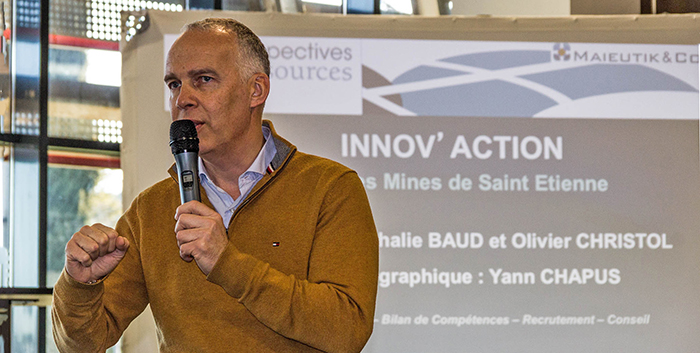
The Innov’actions event last February on campus focused precisely on a topic at the heart of my managerial concerns: the notion of well-being at work as an essential driver of corporate performance. Giving meaning to actions, focusing on future stakeholders and collaborators, is also prepared upstream, and this innovative pedagogical approach aligns with that. This is one of the messages I wanted to convey to the students during these days.
What is your vision of the engineering profession (the role of the engineer) and of ISMIN in particular?
“Tomorrow’s world remains to be invented!” At the heart of today’s many forward-looking reflections and developments, the role and involvement of engineers will be fundamental in how we address humanity’s challenges. Getting around, consuming, producing… changing paradigms; what will be the challenges of virtual reality, microelectronic technologies, sensors, or cybersecurity…?
The future will be shaped with women and men engineers. That is the very challenge of their profession: being both a specialist in a micro-domain and able to develop a cross-disciplinary, systemic perspective to design and conceptualize future projects. A combination of skills that also requires lifelong learning and “learning how to learn.”
Finally, since its creation 8 years ago, I have been very involved in the “Les Entrepreneuriales en PACA” initiative: a multidisciplinary programme that, like the business world, thrives on different profiles. This 6-month entrepreneurial experience fosters exchange and collaboration among students from diverse academic backgrounds, and it is very formative. Wealth comes from diversity. This is one of the lessons each student learns throughout the programme.
The evolution of the nature of the projects students propose themselves is also significant: initially very focused on social networks or mobile applications, they are increasingly moving towards environmental and societal projects (some of which utilize new technologies), which, in my opinion, reveals a growing awareness among young people in general, and future engineers in particular, of the challenges and issues the world faces.
The graduation ceremony will take place on Saturday, November 30, 2019.