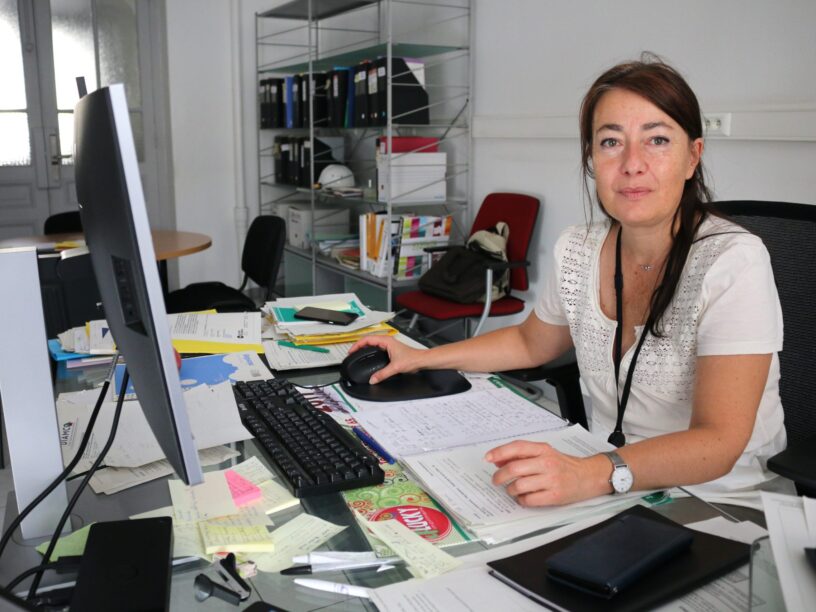
On the occasion of the 40th edition of the European Heritage Days, from September 15 to 17, 2023, the Director of Real Estate and General Services at Mines Saint-Étienne looks back on her role within the institution as well as upcoming projects.
What was your career path before joining Mines Saint-Étienne?
“I earned my architecture degree from the École nationale supérieure d’architecture de Saint-Étienne in 1997. After a period in the private sector, I passed the engineering competitive examination for the local civil service. Once I had this qualification, I held various positions as head of construction and project management in the Loire region, working for a municipality, the department, and then an urban community, at Grand Chambéry in Savoie.”
What are your main responsibilities?
“For eight years now, I have been in charge of the Real Estate and General Services Department of the institution, which primarily includes construction, renovation, maintenance, and logistics for the Saint-Étienne buildings, as well as major structural work on the Gardanne campus. This represents a total of 19 buildings, totaling nearly 66,000 m2. The Department consists of nine staff members, four of whom are supervised by the maintenance and logistics manager for Saint-Étienne. They respond as quickly as possible to repairs and various tasks.”
After a period in the private sector, I passed the engineering competitive examination for the local civil service.
Laure Richard, Director of Real Estate and General Services
Can you tell us more about the work planned for the coming months in Saint-Étienne?
“You are likely referring to the ‘Campus of the Future’ project. It is a very large-scale operation aimed at restructuring the entire historic Saint-Étienne site. This includes everything from restructuring and compliance to energy-saving work, adaptations for new uses, and all outdoor landscaping. The goal of this project is to enhance the campus’s attractiveness by adapting it to new teaching and research challenges. It will take place on an occupied site over an estimated period of six to eight years, with a budget of 35 million euros, funded by a State-Region Planning Contract (CPER). Currently, the operation is in a so-called pre-operational phase, meaning that a programming consultant is being consulted to develop the detailed technical programme, which is necessary to launch the selection process for the project management team. Finally, I should mention that the delegated project management has been entrusted to the University of Lyon.”