

Researchers at the Centre of Microelectronics in Provence (CMP) are working on an innovative project – Flexeo – designed to create miniature chips for prototyping biological and environmental sensory systems.
“Integrated into flexible, ultra-thin, and stretchable supports, these innovative, flexible, and energy-autonomous chips can have applications in the fields of healthcare and the Internet of Things,” explains Sylvain Blayac, a professor and researcher at the CMP who initiated the project.
One part of the Flexeo* project focuses specifically on augmented perception. One of the objectives is to restore tactile sensations for individuals who are deprived of them. Take, for example, a person equipped with a prosthetic hand. Sensors located at the fingertips send data to a microcontroller that translates it into haptic sensations sent back to the forearm. The project’s ambition even extends to implementing augmented perception by integrating electromagnetic field sensors that trigger sensations in case of danger, thus offering proactive prevention.
IoT, Smart Cities, and Environmental Monitoring
The CMP is also working on the development of autonomous communicating objects that are low in energy consumption and capable of collecting and sending data for applications such as smart cities and environmental monitoring. Researchers are exploring solutions where the connected object harvests its energy from the surrounding environment, thereby ensuring increased autonomy. Take, for instance, a permanent air quality measurement device installed in a city that is autonomous thanks to wind energy. Or, in the case of agroecological approaches, the deployment of autonomous sensors allowing for precise agronomic management.
Microelectronics is a strategic sector for the economic sovereignty of France and Europe. Innovating in this sector has therefore become essential, particularly in the Sud region, which accounts for 35% of French semiconductor production.
Jacques Fayolle, Director of Mines Saint-Étienne
The CMP, a key player in microelectronics in the region
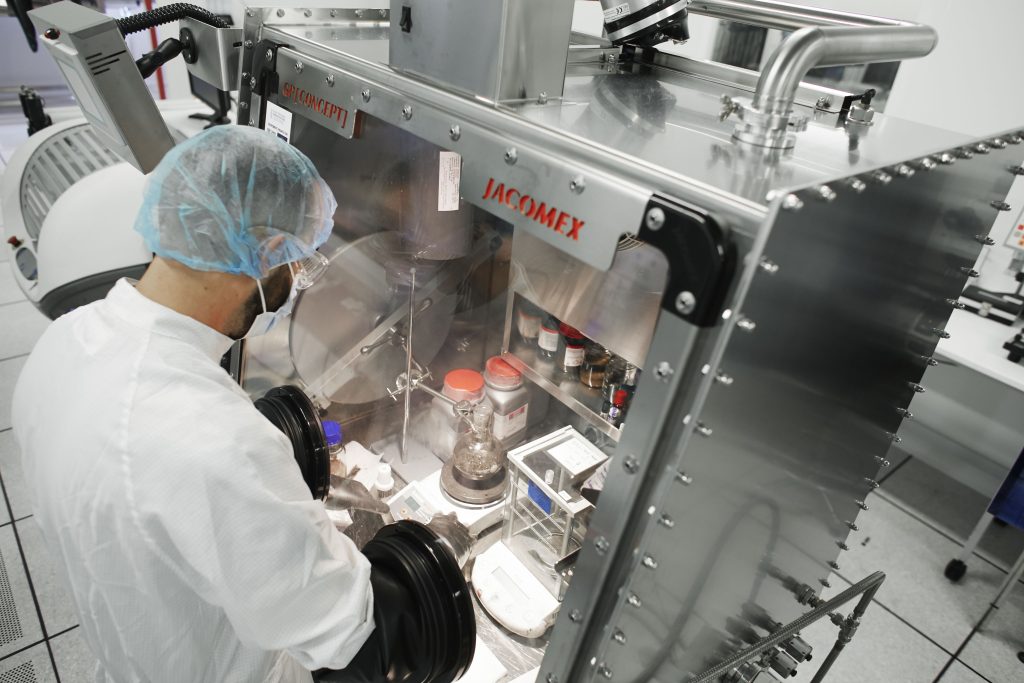
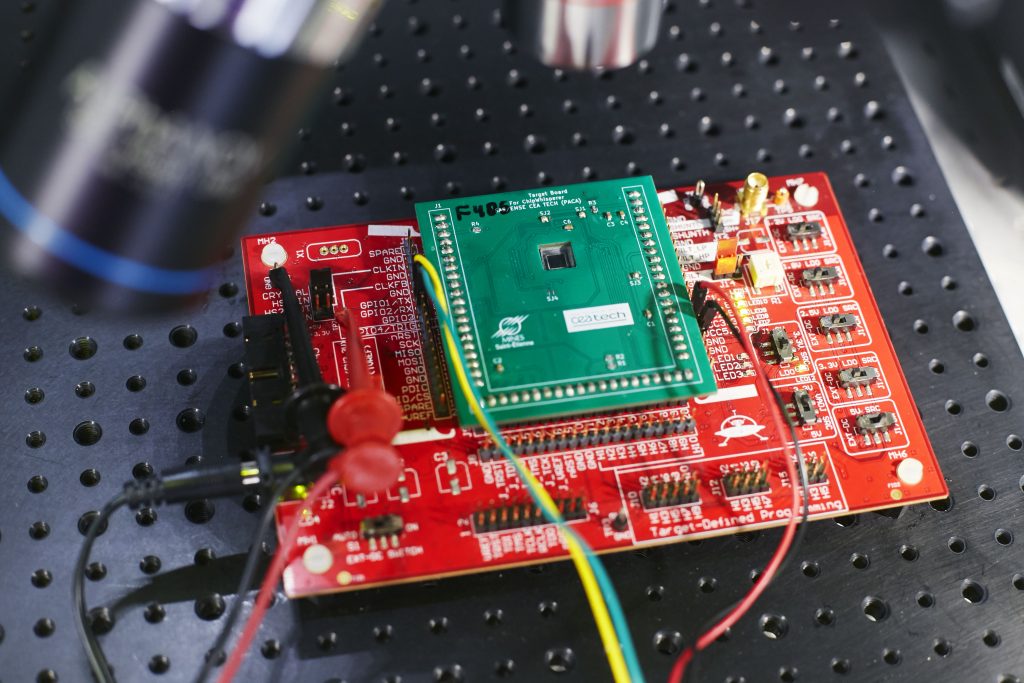
Located on the Aix-Marseille-Provence Campus in Gardanne, the CMP is a key player in microelectronics in the region: high-level engineering training, research into the microelectronics of the future, support for entrepreneurship via the @TEAM scheme, and support for innovation with the ID-FAB (microelectronics prototype design and testing) and Micropacks (cleanroom characterization and packaging of electronic components) technology platforms, etc. Dedicated to microelectronics and its applications, the CMP is a research and training center of the École des Mines de Saint-Étienne. It features 21,000 m2 of state-of-the-art equipment, including a rare 700 m2 cleanroom.
Did you know?
50 years ago, on March 25, 1974, French engineer Roland Moreno filed the first patent for the “electronic payment chip.” This innovation revolutionized transactions by integrating a microprocessor into a portable plastic support, allowing for the secure storage and processing of individual data. The smart card has evolved over the last decades, moving from payment operations to phone cards, SIM cards, transport cards, and more. It paved the way for major advances in microelectronics.
*Flexeo, a project of the Nano 2022 Plan within the framework of the Important Project of Common European Interest (IPCEI) – Funding: Directorate General for Enterprise. Partners: Mines Saint-Etienne – STMicroelectronics.