
Shawn Harquail, Flickr, CC BY-NC
Bernard Guy, Mines Saint-Etienne – Institut Mines-Télécom
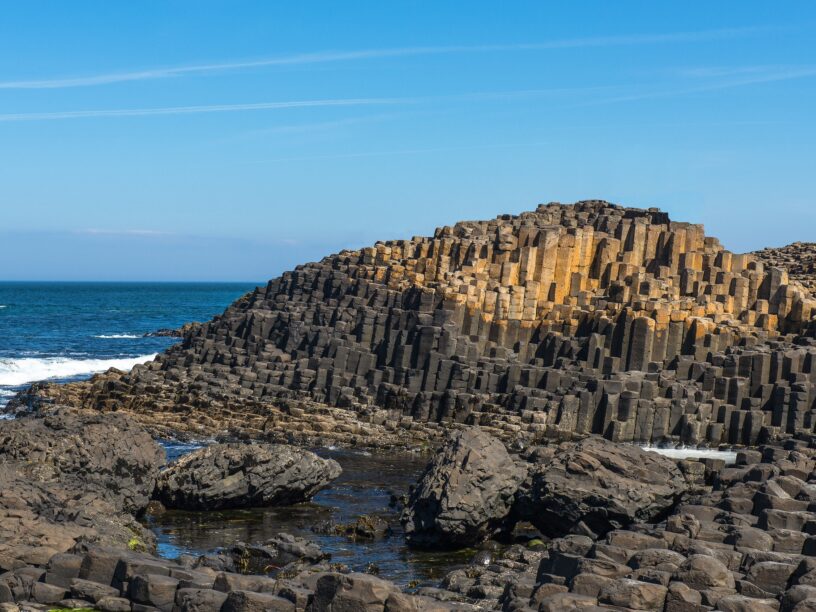
This photograph shows basalt columns. They can be found all over the world, wherever magma flows emitted by volcanoes have solidified and cooled. These spectacular and fascinating structures have been, and continue to be, the subject of extensive research, involving both field and laboratory characterization as well as physicochemical and mathematical modeling.
A well-known example is the Giant’s Causeway in Ireland. There, as elsewhere, the columns can be seen, as well as their cross-sectional structure, revealing the interior of each hexagonal basalt column. This provides a better understanding of how these magnificent structures are formed.
Indeed, the most common explanation for the formation of basalt columns is “thermal contraction.” As basalt rises from the depths of the Earth’s crust, the solid mass cools: it is still hot and not yet structured, but already solidified. The material then contracts, and shrinkage cracks appear, forming the straight outlines of the various hexagons. The analogy often used is that of drying mud, which shrinks to create polygonal patterns. The columns grow perpendicular to the edges of the lava flows and parallel to the thermal gradients.
However, this explanation does not account for all observations: in the cross-section of the hexagonal columns, a circular pattern is sometimes visible. Radial structures originating from the center can also be found, which also follow a cylindrical symmetry.
When small-scale structures help us understand large-scale ones
How can these circular and radial structures be explained? They indicate an early internal structuring of the solid mass, contrary to the hypothesis of the contraction of a homogeneous solid mass.
Materials science provides valuable clues. Indeed, metallurgists specializing in the solidification of metal alloys observe similar columnar structures in their ingots. Under specific thermal gradient conditions, the interface between the liquid and the solid exhibits “fingering”: fingers of solid develop and advance into the liquid. They eventually fuse together, which creates the columns. Subsequent thermal contraction of the solid mass may, depending on the case, separate the previously formed prisms.
The aforementioned fingering mechanism may play a role in the columnar jointing of volcanic rocks: it helps explain the circular and radial structures, as well as the overall organization of the flows where both mechanisms (contraction/fingering) can occur. Finally, it accounts for the characteristics of the somewhat unusual columns discovered in the Ricamarie slag heap near Saint-Étienne, where coal residues burned within sandstone and argillite to form magmas.
Bernard Guy, Professor and Researcher, Mines Saint-Etienne – Institut Mines-Télécom
This article is republished from The Conversation under a Creative Commons license. Read the original article.