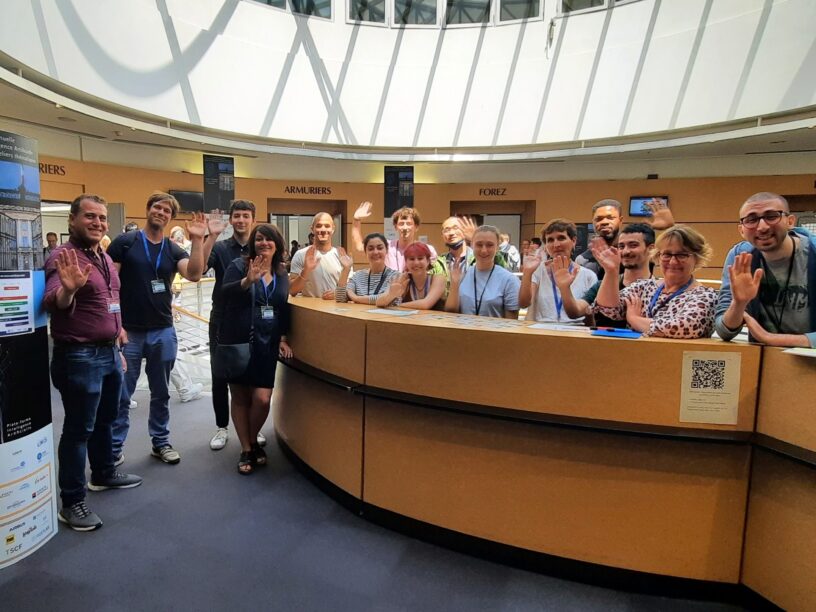
Mines Saint-Etienne organised for the first time the Artificial Intelligence Platform (PFIA), an event that brings together, over the course of a week, the French-speaking Artificial Intelligence community. This 2022 edition took place from 27 June to 1 July at the Saint-Etienne Convention Centre, featuring conferences, workshops…
PFIA: the annual meeting on Artificial Intelligence
Last month, the French-speaking Artificial Intelligence community met in Saint-Etienne to take part in the Artificial Intelligence Platform 2022 (PFIA 2022). After two years held remotely, it was the first time the Platform was once again held in person, to the delight of participants, who could finally meet face to face to interact, share and exchange in person.
In charge of the organisation, Mines Saint-Etienne had, for the occasion, mobilised the researchers of the Henri Fayol Institute through its Computer Science and Intelligent Systems department, as well as the Saint-Etienne Convention Centre.
A rich programme
Thus, over the course of a marathon week on Artificial Intelligence, from 27 June to 1 July, there were no fewer than 8 conferences, 5 days of workshops, hundreds of presentations, tutorial sessions running throughout the week, a creative arts workshop using Artificial Intelligence, and a showcase of regional Artificial Intelligence work, offered to the 450 participants—researchers, professionals, industry representatives and students.
This already rich programme was also complemented by an “OFF” programme with Festiv’IA to discover Artificial Intelligence in a different way, organised by La Rotonde, which offered film screenings and discussions, workshops, panel discussions, urban displays, and music generated by Artificial Intelligence.
At the end of this memorable week, the Mines Saint-Etienne organising team is pleased to pass the torch to Strasbourg for PFIA 2023.
The Artificial Intelligence Platform 2022 was organised by Mines Saint-Etienne, the French Association for Artificial Intelligence, Institut Mines-Télécom, and the Laboratory of Computer Science, Modelling and Optimisation of Systems (LIMOS).
It was supported by: