As part of the Information Technology and Supply Chain (ITS) technological challenge, taught in the third year of the ISMIN program, engineering students were invited to visit the Port of Marseille on January 18. The objective of this visit was to understand the importance of logistics in a port undergoing major restructuring.
Experience report by Alain Soulignac, Class of 2016.
The Port of Fos-Marseille is a structure resembling an open-air warehouse. This opening sentence aptly summarizes this logistics giant employing over 44,000 people in the Bouches-du-Rhône basin. Ask the people of Marseille what they think of the port and they will answer with an accent that will tickle your eardrums: “The autonomous port of Marseille? peuchère, it’s family.”
A visit to the Port of Marseille is always special, and Nabil Absi, a researcher-lecturer in the Manufacturing Sciences and Logistics department and organizer of the day, would certainly agree. “I visit the port every year and I always learn something new,” he explains.
To fully understand why the Port of Marseille is so remarkable, one must recognize that it is located in two different places. Indeed, for the people of Marseille, managing one port was too simple, so they decided to build a second one in Fos-sur-Mer. Larger, more modern, and more competitive, this second port allows all ships from Asia, Eastern Europe, and the Middle East to unload their cargo in Europe.
This new port is a multimodal structure. It can be reached in multiple ways. By road, which is actually what we did—a rather straightforward strategy. By sea, classic and unoriginal. Via the Rhône, which flows into the sea nearby—a clever strategy from Lyon but not from Bordeaux. By rail, which simplifies many things, especially if you have a TGVmax card. The ultimate method, in my opinion the most relevant, is via the pipeline from Switzerland. This allows the transport of all types of liquids—oil, cooking oil, and Swiss melted cheeses—methods that move over one million tons of goods.
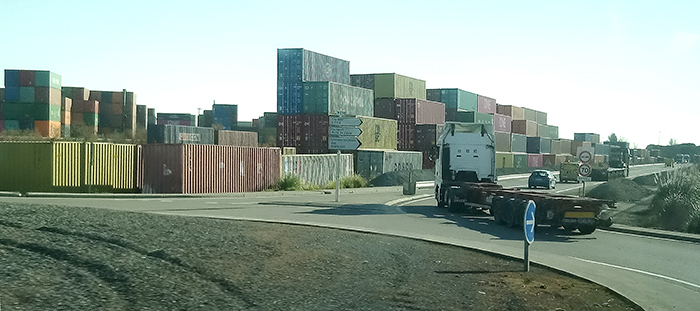
At Fos-Marseille, we don’t speak of unloading docks but of darses. It’s the same but different. Ships dock there and are unloaded, but it’s larger than a dock. There are two darses at Fos, positioned to be sheltered from the wind to facilitate easier unloading of products.
The most impressive thing at Fos is the color: indeed, each carrier has chosen a different color to clearly identify its containers. As a result, when you observe a cargo unloading area, it’s like looking at your little niece’s multicolored birthday cake.
I mentioned Fos, but what about Marseille? The Port of Marseille is a monument. The people of Marseille tried to have it listed as a UNESCO World Heritage site, in the “religious monument” category, but they received no response from the organization.
More seriously, the port is currently undergoing major restructuring. The people of Marseille are seeking to reinvest in infrastructure, some of which dates back over 200 years.
Form 10 is the perfect example (a form is basically a hole in which a ship is placed in dry dock for repairs). Abandoned 10 years ago, it is now under construction, and its order book is already well filled.
According to our guide, a Marseillaise at heart, the Port of Marseille is a bit like PSG in football. I’m not sure she would appreciate the comparison, actually. But listening to her, one senses a particular, almost absurd attachment to a structure whose logistics are simply impressive. Marseille and its port—it’s a whole love story.