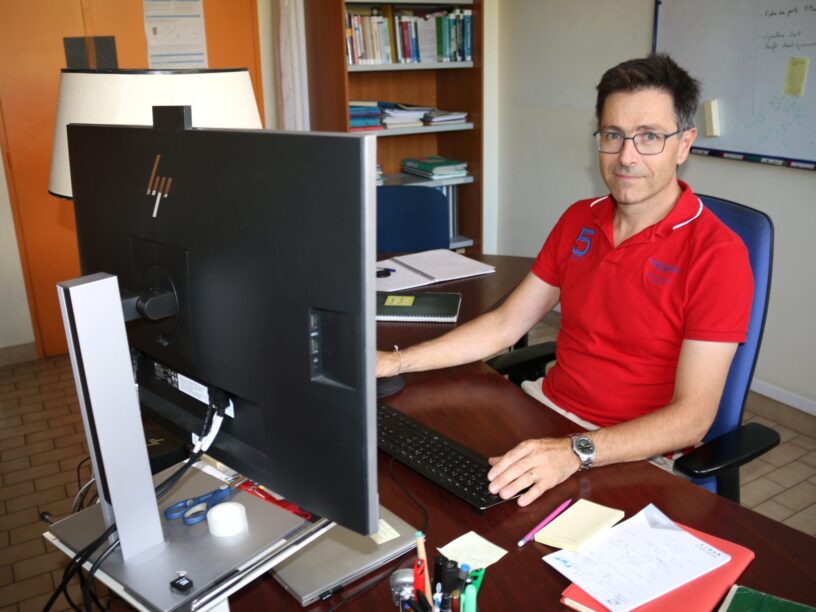
Olivier Bonnefoy, project leader and professor-researcher at the Centre for Chemical Engineering (SPIN), explains why this collective success is a major milestone.
What does this project involve and who is it for?
“It involves the creation of a new Master of Science in Engineering level curriculum open to the best students from around the world. Over two years, the 32 students (including 22 scholarship holders) who join will gain expertise in multiphase systems—in other words, systems made up of grains, bubbles, or drops, such as aerosols, pastes, powders, and foams. The fields of application are numerous and largely relate to sustainable development: hydrogen, recycling, reprocessing, CO2-free electricity, and more. This new pathway, combining theoretical courses, practical work, and internships, is international in its recruitment. It is also international in its pedagogy, as classes will be held alternately at Mines Saint-Étienne, the Polytechnic University of Turin, and the Technical University of Munich. At the end of the programme, taught in English, students will earn not one but three degrees from the various institutions attended. The first cohort is scheduled for September 2024.”
It must have been a long road before receiving a positive response from the European Commission?
“It did indeed require long and significant work led by all the staff at the SPIN centre and the cross-functional departments of Mines Saint-Étienne, with the support of the Institut Mines-Télécom, the Auvergne-Rhône-Alpes Region, and the Axelera competitiveness cluster. Fourteen months of preparation, 2,000 emails sent, and about fifty video conferences were necessary to submit the 267 pages of our application file just 36 minutes before the deadline set by the European Commission. Our efforts were finally rewarded, and we can be proud. There are approximately 5 Erasmus Mundus grants awarded in France each year. With a 5.5 million euro grant awarded by Europe, we have a solid budget to launch and organize the first four cohorts. As the coordinator of this high-level educational pathway, we have a responsibility to uphold and objectives to meet.”
With a 5.5 million euro grant awarded by Europe, we have a solid budget to launch and organize the first four cohorts.
Olivier Bonnefoy, project leader and professor-researcher affiliated with UMR CNRS 5307 LGF
Why was this project so important to you?
“I am passionate about my profession and research. Over time and through my personal experiences, I realized that the SPIN centre at Mines Saint-Étienne had a level of expertise that rivalled prestigious international institutions. We therefore had a card to play, and that is why I wanted to submit our application for this project supported by the European Commission. I am convinced that this structuring training has its place here and in the schools associated with this great adventure, which aims to promote the excellence and internationalization of higher education institutions (HEIs) through jointly organized Master of Science in Engineering level study programmes.”
Contact: bonnefoy@emse.fr