
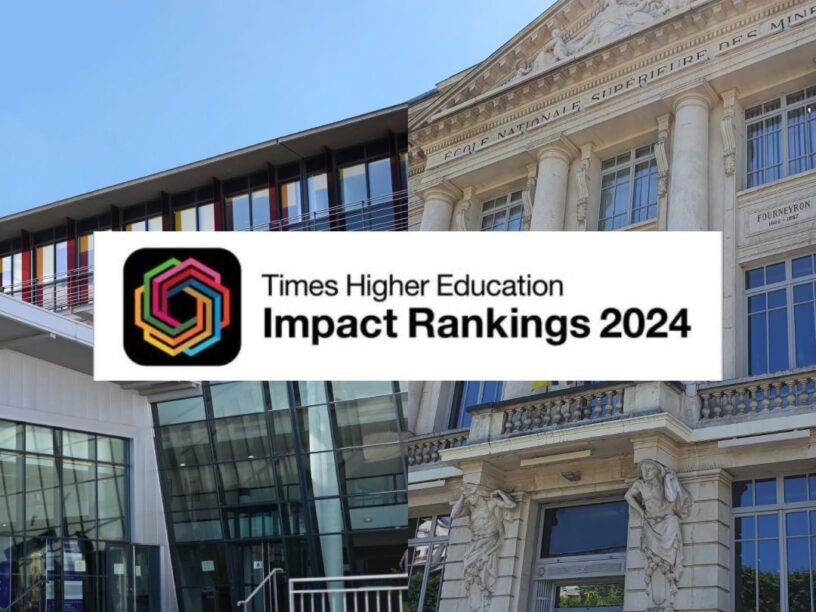
The School strengthens its position in the top 300 of the overall ranking (ranked 201–300 out of 1,963 institutions ranked) with a score of 82.4/100. Last year, it scored 77.2/100.
Published by Times Higher Education, a leading British monthly in the academic world, the annual IMPACT ranking assesses higher education institutions worldwide against the 17 Sustainable Development Goals (SDGs) defined by the UN, based on their scientific output, teaching, and practices.
Mines Saint-Étienne performs strongly across the board
For the first time this year, Mines Saint-Étienne is included across all 17 SDGs.
The School stands out in particular in the top 100 for 5 SDGs (2 more than in 2023), including SDG 13 – Climate Action and SDG 11 – Sustainable Cities and Communities. It also ranks in the top 200 for 4 SDGs, including SDG 17 – Partnerships, one of the flagship goals of the ranking.
This outstanding performance makes Mines Saint-Étienne the leading institution in Auvergne-Rhône-Alpes and in the Sud region, alongside Aix-Marseille University.
And David Delafosse, Director of the Aix-Marseille-Provence Campus, added: “These results are the outcome of our strategy: to confirm our status as a pioneer and make sustainable development the driving force behind all of the School’s thinking. The ranking highlights our ongoing innovations in research, education, transfer to industry, the dissemination of scientific culture, and above all in our day-to-day practices and our choices as an institution .”
Ongoing commitment to tackling climate change
At Mines Saint-Étienne, tackling climate change and ensuring the sustainability of cities and communities are an integral part of research activities. This is reflected in particular in:
- The writing of a PhD thesis, in collaboration with France Villes Durables and funded by IMT’s Futur et ruptures programme, on the topic “Assessment of territorial public policies on land use in light of social justice challenges and the planetary boundaries framework.”
- The completion of its own carbon footprint assessment in 2010. In 2015, the approach was institutionalised and the School implemented a strong policy to ensure that campuses comply with energy-efficiency standards. This policy is delivering results: between 2019 and 2022, the School’s overall CO2 consumption was reduced by 19%.
- Education, with the integration of dedicated modules in the 1st and 2nd years of the various programmes.
- The presence of its own centre for scientific, technological and industrial culture: La Rotonde. Established in 1999, it aims to foster curiosity and interest in science and technology among all audiences.
Strong commitments with international organisations
The ranking for SDG 17 recognises partnerships between institutions and organisations (NGOs,
Associations, Institutions, etc.) that place sustainable development at the heart of their concerns.
Mines Saint-Étienne teams are therefore involved in several organisations.
Faculty-researchers contribute to discussions on industrial standards with the W3C and AFNOR. Michelle Mongo, a researcher at Mines Saint-Étienne, works on sustainable development projects with the International Organisation of La Francophonie. Guillaume Desbrosse, Director of La Rotonde, is also a board member of the EDF Foundation.