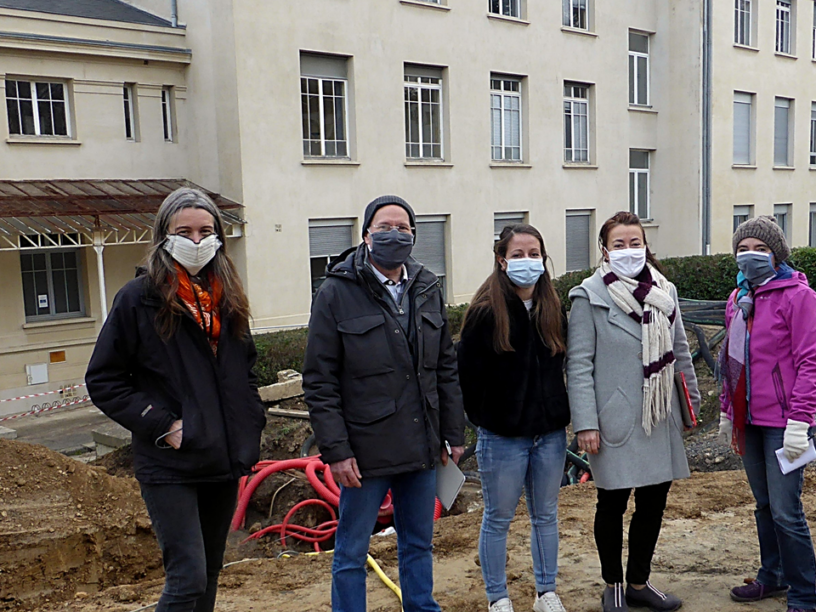
As early as 2005, the School established a Sustainable Development and Social Responsibility (SDSR) delegation. It is responsible for implementing and promoting the ecological transition and social responsibility across all the School’s activities: teaching (faculty and students), research, administration, and campus life. Meeting with the delegation:
What is the SDSR delegation?
It is composed of about twenty volunteers representing the various departments, campuses, and research centers, as well as, since this year, students from the ICM and ISMIN programs.
“The SDSR (Sustainable Development and Social Responsibility) delegation is responsible for implementing and promoting the ecological transition and our social responsibility across all our activities: teaching (faculty and students), research, administration, and campus life. It is composed of about twenty volunteers representing the various departments, campuses, and research centers, as well as, since this year, students from the ICM and ISMIN programs. It is co-led by the SDSR delegate, Natacha Gondran, and by Sandrine Bonny, Quality, Safety, Security, and Environment Engineer. The delegation meets approximately every two months to discuss actions taken, ongoing or proposed initiatives, and exchanges with management. A mailing list bringing together the members of the delegation also allows for the exchange of information on the subject of ecological transition and social responsibility. Every 6 months, the delegation leaders present the various actions and proposals of the delegation to the school’s executive committee as part of the “CoRSE” (Institutional Social Responsibility Steering Committee).
What is the role of the delegation?
Discussing actions that the school is implementing, or could implement, to reduce its environmental impact and improve its social responsibility
The objective of the SDSR delegation is to enable a network of people working or studying at Mines Saint-Étienne to discuss actions that the school is implementing, or could implement, to reduce its environmental impact (waste management, promotion of active mobility, for example) and improve its social responsibility (particularly through the diversity mission led by Hélène Pangot). The SDSR delegation is thus primarily a forum for exchange between people who did not necessarily know each other before joining, but who share these common concerns of “doing better” in our various professions to better respect the environment and have a strong social role as a public higher education institution. In the School’s organizational chart, the SDSR delegation reports directly to the Director of the School. This is why, every 6 months, we lead a Social and Environmental Responsibility Steering Committee (CoRSE) to present the actions carried out within the delegation to the members of the executive committee. This approach is formalized within the framework of the SD&SR label from the Conférence des Grandes Écoles (CGE) and the Conférence des Présidents d’Université (CPU), which we renewed in 2021.
What does the sobriety plan developed by the School consist of?
The Mines Saint-Étienne sobriety plan is based on three themes: energy, mobility, and digital technology. All actions carried out are structured around these three themes through eco-gestures, reasonable and reasoned consumption, responsible purchasing, and awareness-raising.
The School’s Sobriety plan is part of the State’s initiative which aims to enable France to end its dependence on fossil fuels and reduce its energy consumption by 40% by 2050. These objectives require a lasting transformation of our habits and behaviors. Specifically, the Mines Saint-Étienne sobriety plan is based on three themes: energy, mobility, and digital technology. All actions carried out are structured around these three themes through eco-gestures, reasonable and reasoned consumption, responsible purchasing, and awareness-raising. These actions complement heavy investments being made elsewhere in the buildings (particularly at 158 at the moment) to improve their energy efficiency. The School’s Sobriety plan supports the measures implemented to achieve the commitments made for the reduction of greenhouse gases emitted in the Mines Saint-Étienne sustainable development strategy.
In conclusion, if these subjects interest you and/or you have ideas for concrete things that Mines Saint-Étienne could do to reduce its environmental impact and improve its social responsibility, do not hesitate to contact Sandrine Bonny or Natacha Gondran, or to submit your ideas for sobriety actions via the suggestion boxes in the buildings or on the internal portal.