It is officially recognised as a key player in innovation in the fields of health and autonomy in France.
This is a fine and well-deserved recognition that MedTechLab has achieved since January 18, following the announcement made by the Digital Health Delegation (DNS) during the National Day for Innovation in Digital Health at the Beffroi de Montrouge (92).
MedTechLab has indeed won the call for projects Experimentation Hub, which is part of the acceleration strategy “Digital health” under the France 2030 plan.
Led by Mines Saint-Étienne, AÉSIO Santé and AÉSIO mutuelle, MedTechLab is a living lab dedicated to real-world testing of new products or services that integrate innovative technologies for the health and autonomy of older adults.
We will be more visible to public-sector stakeholders and industry. We will be able to respond to public calls for projects that we were previously not eligible for, and we will be listed by the ANS, which will now be able to direct industrial partners to us. Moreover, this recognition marks a strategic turning point that will enable us to structure ourselves and move into the clinical study phase. We will now be able to offer industrial partners a complete service from concept to delivery of the minimum viable product, including training. . “.
Vincent Augusto and Guillaume Gardin, co-directors of MedTechLab
€1.2 million will be allocated to MedTechLab to ensure the long-term sustainability of the living lab, develop its activities, and fund two specific sub-projects: ANA* and ESLIB**.
Training programmes for decision-makers will also be introduced this year. For example, MedTechLab will be the experimentation site for the European project Co-Creative Decision-Makers for 5.0 Organizations (CoDEMO 5.0), which aims to design the curriculum for tomorrow’s healthcare managers.
To acquire the skills required for this development, MedTechLab will create five jobs by the summer.
* ANA : carried out with the start-up Dynseo, the project aims to identify cognitive disorders in older adults at an early stage via a mobile application—a serious game—that makes it possible to perform, in a playful way, the tests usually used during a memory clinic consultation. This innovation will make it possible to establish a diagnosis and propose appropriate care in areas where medical demographics are under strain.
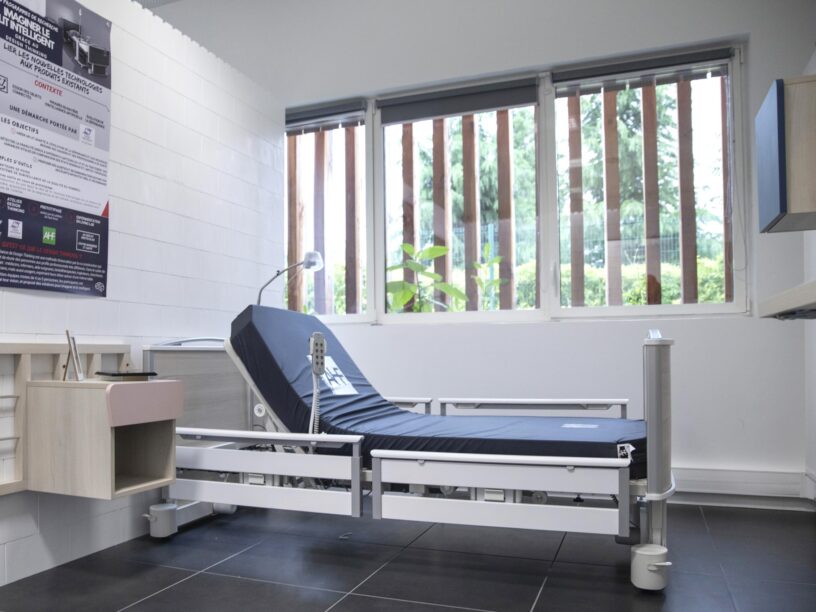
** ESLIB : carried out in partnership with the Ateliers du Haut Forez, the project makes it possible to assess sleep efficiency in older adults using a smart bed equipped with a ballistocardiographic (BCG) sensor. The study evaluates the effectiveness of a BCG sensor on a medical bed to analyse sleep, compared with polysomnography (considered the reference test), turning the bed into a non-invasive sleep analysis system.