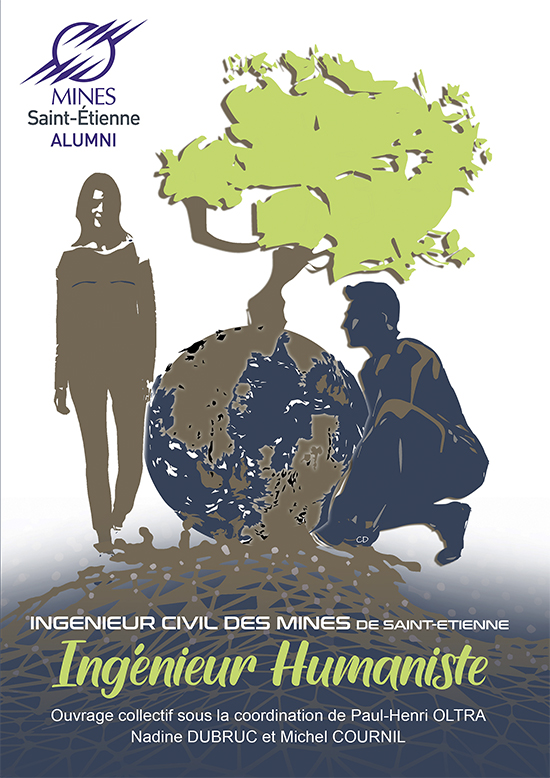
“The humanist engineer takes responsibility by considering human, societal, and environmental concerns at least as much as other objectives. Our engineers bear this heavy responsibility: to innovate in order to preserve.”
This collective work was written in collaboration with alumni and ICM students, under the coordination of Paul-Henri Oltra, Nadine Dubruc, and Michel Cournil.
The aim of this book is to shed light on this topic through:
• “What the history of Mines Saint-Étienne tells us. Great alumni have shown exemplary and inspiring conduct. What was it like at the École des Mines? Were these personal initiatives, or are we looking at the DNA of the School’s graduates?”
• “What the School is doing today. We present the human dimensions of teaching at Mines Saint-Étienne, the training delivered, as well as contributions from students.”
• “Testimonials from graduates. Their presentations, life stories, or suggestions show what an engineer may decide to do when their humanist dimension is put into action.”
“Humanism is a life journey, a learning process about life and the relationships between the individual and their environment. Education, training, and practical experience play an important role. Engineering education must enable the emergence, or the development, of a humanist conscience. It is no longer a philosophy, or a luxury, but a necessity.”
“Humanism has become essential; its holistic approach is indispensable to save the planet. Our engineers, “innovative by
tradition”, bear this heavy responsibility: to innovate in order to preserve.”
“Ingénieur Civil des Mines of Saint-Étienne. Humanist Engineer” was coordinated by Paul-Henri Oltra, ICM E81, Nadine Dubruc, Institut Fayol, Michel Cournil, ICM E70. It is prefaced by Pascal Ray, Director. Xavier Olagne, ICM E84, wrote the introduction to the section on current training.
It can be ordered here (information and excerpts):
https://www.thebookedition.com/fr/ingenieur-humaniste-p-372695.html