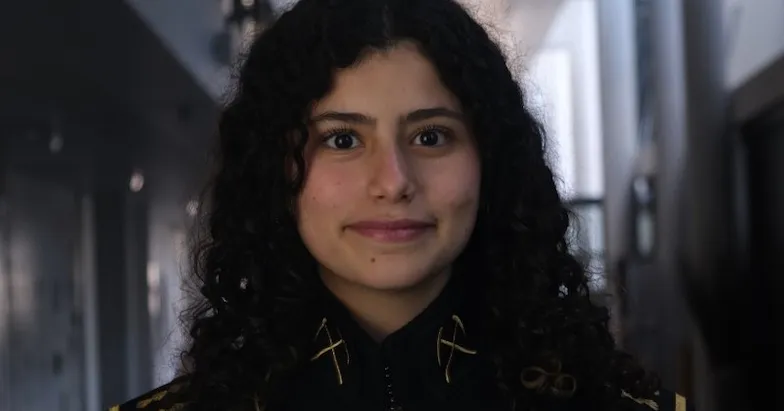
Originally from Lebanon, Léa Sarkis is an ISMIN student at the Aix-Marseille-Provence campus. She was elected President of the Student Union (BDE) to give students a voice, promote inclusion, and coordinate relations between the School and other associations. Today, she shares her missions, her motivations, and the pivotal role the BDE plays in Gardanne.
Can you introduce the Student Union?
The Student Union of the Aix-Marseille campus of the École des Mines de Saint-Étienne (official name “BDE EMSE CGCP”) is above all the voice of the students. It represents them to the School, but also to external stakeholders: partners, other schools, local institutions, and student associations. It serves as a bridge, but its role goes beyond simple communication: it must understand the students’ mindset, convey their expectations, and make decisions that reflect them and embody their values.
The Student Union seeks to bring the campus to life daily through its actions. It supports projects, creates friendly moments, accompanies initiatives, and transmits the School’s spirit beyond its walls, particularly in Aix-en-Provence and Marseille, where we want to further integrate our campus into local student life.
The Student Union must also embody student well-being because mutual support occupies a central place: it brings students together, facilitates exchanges, and coordinates links with the ten other campus associations, so that student life remains dynamic, open, and accessible to all.
Inclusion is an essential pillar of the Student Union. Everyone must be able to find their place on campus, regardless of their background, origin, or profile. This is why the international club was created two years ago, in order to fully integrate international students into student life and the School’s key moments.
The Student Union also has a mixing club, Mix’Mines, which allows students to discover the world of music, lighting, and events. This club plays an important role in the campus atmosphere, contributing to creating memorable evenings for students.
Beyond its clubs, the Student Union is organized around several divisions: Events, Travel, Safety, Integration, Communication, Management, Visual, and Partnerships. Each contributes to the smooth functioning of student life. The board coordinates these divisions, sets priorities, and carries the vision of the mandate.
What are your missions within the association?
The role of Student Union president is both that of legal and moral representative of the association. It is somewhat as if they personified the Student Union in the eyes of the law, the School, the students, and external stakeholders, acting as guarantor of the association, its image, and the values it conveys.
Within the Student Union, the president must act as a reference point. They are there to guide discussions, provide direction, and support action when necessary. It is not someone who imposes their decisions, but someone who carries a vision: knowing where the association should go, what it should defend, and what it should represent.
As president, I must also embody the Student Union’s values, ensure I remain faithful to its spirit, and give the best possible image of my school and the students who comprise it.
Concretely, a large part of my role relies on communication with external stakeholders: the School, the MDE, the alumni association, partners, and other schools. This involves reporting issues encountered by students, but also building projects that strengthen our campus’s visibility and further open our student life to other engineering schools. These initiatives always have the same objective of improving and energizing student life for our school’s students.
In parallel, it is also team management work. I must coordinate the divisions and the board, understand treasury, administration, and internal organization issues, even when these missions are carried out directly by other members. My role is to orchestrate everything, maintain an overall vision, and ensure that projects move forward collectively and dynamically.
What I wish to accomplish throughout my mandate is also to become an accessible person, to whom students can come when they have a problem, an idea, or a concern. I want to be someone they can count on to report difficulties, change what needs to be changed, and concretely improve campus life.
What were your motivations in applying?
On a personal level, I am someone who is naturally very open, sociable and attentive. I moved from Lebanon to France at the age of 16, and this experience taught me a lot about opening up to new people and adapting to a new environment, which may not be obvious for everyone.
It also made me understand how important inclusion is for a person’s well-being in their student life in particular. I think it is one of my strengths, because I can quite easily adapt to others and to particular situations and I truly have a desire to include everyone.
I particularly enjoyed the integration, the events that bring together as many people as possible and everything that creates a real spirit of cohesion.
I cannot deny that being a small class worried me at first. One might think that we will quickly get bored, especially when comparing ourselves to other schools. But in reality, it creates a very family-like environment, with a particular warmth. This is precisely what I wanted to convey: ensuring that as many students as possible feel this cohesion and find their place.
After the integration, I felt that there was still a lack of connection in our class. This motivated me to bring together people from different friend groups on campus to form a Student Union list. My objective was not to build a list only with my friends, but to create a representative group, capable of bringing people together broadly and that includes everyone.
It was a gamble, because bringing together different profiles could also create tensions. But according to the feedback I received, it mainly created new friendships, mixed groups and helped several people fully integrate into student life.
How does the Student Union play its role as liaison between the School and other student associations?
The Student Union coordinates grouped subsidy requests for all campus associations. These requests are then presented by the Student Union in the form of a file, then defended before several important stakeholders of the School and the Alumni association.
Preparing this file requires considerable work. Associations must first send us their projects, needs, and budgets. Then, the Student Union centralizes them, reorganizes them, and seeks to build a coherent collective request, finding a balance between each association’s needs. The objective is that each can develop, carry out its flagship projects, and continue to bring the campus to life.
This makes communication between the Student Union and other associations essential. We must listen, understand each one’s priorities, and sometimes find compromises.
The Student Union also participates in Student Life Office meetings. These meetings may include other associations when discussing important projects with representatives of the school and the Student House. They allow linking students, associations, and administration.
What are your upcoming projects?
Our next major event is the pre-integration, a key moment that brings together the entire class, giving us memories of the beginning of the year. It is an opportunity for the Student Union and associations to prepare the integration period events coming at the next academic year, and to “test” them by creating shared memories to strengthen cohesion and bring the class spirit to life through competitions between families.
In parallel, we also organize more informal moments, such as beach outings or impromptu barbecues. The objective is simple: bring together as many people as possible whenever the campus becomes a bit too quiet, and maintain a real dynamic of student life throughout the year.
We warmly thank Léa Sarkis for answering our questions. We wish great prosperity to the ISMIN Student Union and congratulate the students who are committed to inclusion and community life on the Aix-Marseille-Provence campus.