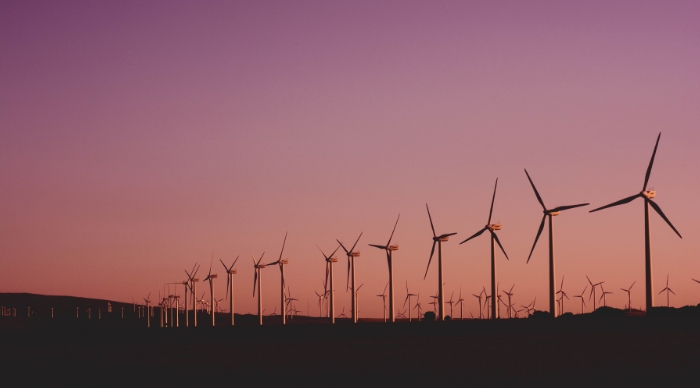
While the sector accounted for more than a third of Germany’s total net electricity generation in March 2019, wind power in the country is now in crisis. The blame lies with the 2016 amendment to Germany’s energy law, along with a growing popular backlash against wind power. An update on the German wind power crisis with Mines Saint-Étienne.
Wind power: the reasons behind a predicted decline
The introduction of the new remuneration model for capital invested in wind power is slowly but surely driving the sector to collapse across the Rhine. From 2021 and throughout the 2020s, many wind turbines, solar photovoltaic installations and pioneering biogas plants in Germany will stop receiving fixed feed-in tariffs, or “guaranteed revenues,” over 15- to 20-year periods provided for in the German Renewable Energy Sources Act (EEG). The amendment to the EEG, which removed guaranteed revenues—considered too burdensome for taxpayers (to the great disappointment of industry)—in favor of a competitive tendering system, means that many gigawatts of renewable energy capacity will be lost. For industry players, there is little incentive to invest in the sector if feed-in tariffs are no longer guaranteed, especially as foreign competition is fierce. A few months after the 2016 EEG amendment, 26,000 jobs were cut in wind power, according to figures released by the Bundestag (the German national parliament).
Add to this the social factor, namely the growing rejection among the German population of the ecological and human impacts of wind technology, which delays project timelines. Today, there are more than 600 citizen initiatives against new wind farm installations in the country.
German wind power: facts and figures
It should be noted that, until the drastic slowdown in installations in 2018, Germany long dominated the European ranking for onshore wind turbines. With gross expansion of around 5,300 megawatts (MW), 2017 saw the strongest capacity growth ever recorded across the Rhine. Expansion slowed by more than half in 2018, to just 2,402 MW, and fell to its lowest level in nearly 20 years in the first half of 2019, when only 287 MW were added.
Until very recently, Germany favored wind power for two main reasons: most of the country was not known for abundant sunshine, and energy companies did not have to change their business model for large wind farms, as opposed to a multitude of smaller solar installations. As a result, in 2018, according to BloombergNEF, around 17% of Germany’s energy came from wind power and only 7% from solar energy. According to the International Renewable Energy Agency, Germany accounted for 29% of global exports of wind technology and equipment and barely 5% in solar energy. And last year, the wind industry employed nearly 141,000 people in Germany, compared with fewer than 30,000 in the solar industry.
Solar overtakes wind power
According to a 2018 study by the Fraunhofer Institute for Solar Energy Systems, the cost of solar power generation will fall faster over the next 17 years than the cost of wind power. By 2035, photovoltaic installations in southern Germany, where sunshine is more abundant, will produce energy that is significantly cheaper than any other type of installation. And even in northern Germany, which is less sunny, solar energy produced by industrial-scale installations will be roughly as cheap as onshore wind power.
Predictions in Germany are fully in line with the current global trend: the global average cost of solar power generation fell by 77% between 2010 and 2018, compared with a 35% drop for onshore wind over the same period. Technological progress is behind the reduction in solar energy costs. The decline in solar panel prices has recently slowed, but in the long term, the potential market—and therefore potential economies of scale—appears greater for solar than for wind. A solar panel can be installed on every roof if it is cheap enough, but wind turbines require much more space.
A summit to save German wind power
On Thursday, September 5, 2019, German Minister for Economic Affairs Peter Altmaier convened a closed-door meeting of around fifty figures—including business leaders, experts, environmental activists and regional elected officials—to try to save wind power in Germany. That was, in any case, the stated ambition of the “wind energy summit” in Berlin: to save a sector that has been faltering for a year.
The main challenge is to counter the slowdown in the construction of onshore wind turbines, as Mr. Altmaier readily acknowledges, figures in hand. In 2018, 743 onshore wind turbines were built in the country, compared with almost 1,800 units in 2017. In 2019, the situation is even more alarming: only 86 turbines were built during the first six months of the year. According to the German Wind Energy Federation (EBW), the number of new turbines installed in the country has fallen by 82% since the start of the year. Achim Derks, Deputy Managing Director of the Association of German Chambers of Industry and Commerce (DIHK), said on the matter: “As far as onshore wind expansion is concerned, Germany has moved from the fast lane to the hard shoulder.”
Yet Germany’s ambitions in renewable energy have been widely praised, all the more so as the country wanted to move away from nuclear power and coal, considered too polluting. The country plans to shut down its last nuclear power plant by 2022 and end coal use by 2038. To achieve this, the share of renewables in the energy mix across the Rhine will need to reach 65% of electricity generation, compared with 40% today.
Fully aware of the challenges of the energy transition, Mines Saint-Étienne offers a “Energy Recovery Engineering” programme, which meets the needs for energy optimisation of industrial infrastructure.