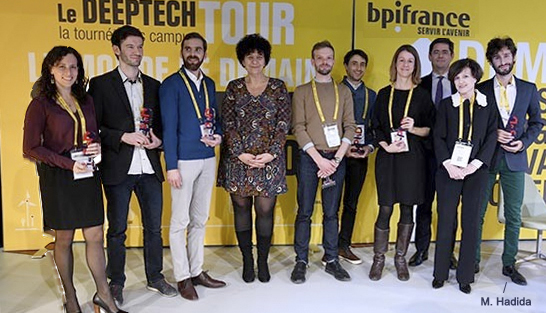
For its first edition, the i-PhD innovation competition awarded 29 winners, including 7 Grand Prizes: among them, Mikhaël Hadida, a Mines Saint-Étienne PhD graduate, from the Centre for Biomedical and Healthcare Engineering / SAINBIOSE INSERM U 1059, leader of the “STREAM” project and winner of the PULSALYS Young Researchers Programme 2019.
Mikhaël Hadida presented his project at the awards ceremony on February 6, in the presence of the Minister of Higher Education and Research and the CEO of BPI France.
The “Bone STREAM” project aims to design and validate a system for the in vitro culture of bone tissue models. The device’s structure allows for the control of mechanical parameters, and the system will enable the retrieval of key data in real time.
The direct benefits include a drastic reduction in the cost, time, and ethical burden of research, particularly in the following applications:
• the development of advanced therapies;
• assistance in the manufacturing of living bone grafts for regenerative medicine applications;
• screening of osteo-active or anti-cancer molecules as a replacement for animal models;
• the integration of a bone tissue model into “body-on-chip” systems currently under development, comprehensively recapitulating human physiology.
“Participating in this competition represented a real opportunity for me to gain more visibility and support for the development of my project, carried out within the SAINBIOSE (INSERM U 1059) laboratory and developed by PULSALYS“
Mikhaël Hadida, winner of the 2019 Grand Prize, defended his thesis in December 2019 in the specialty Mechanics and Engineering.
The first edition of the i-PhD Competition, organized by the Government and Bpifrance, was launched in July 2019. The national jury met on November 27, 2019, before the official awards ceremony on February 6, 2020, at Paris-Saclay University.
“At the origin of the i-PhD competition is an ambition: to meet the major challenge of doubling the number of deeptech startups in France. How? By supporting young PhD graduates wishing to valorize their research work and who can demonstrate support from a public laboratory and a Technology Transfer Office (TTO).”