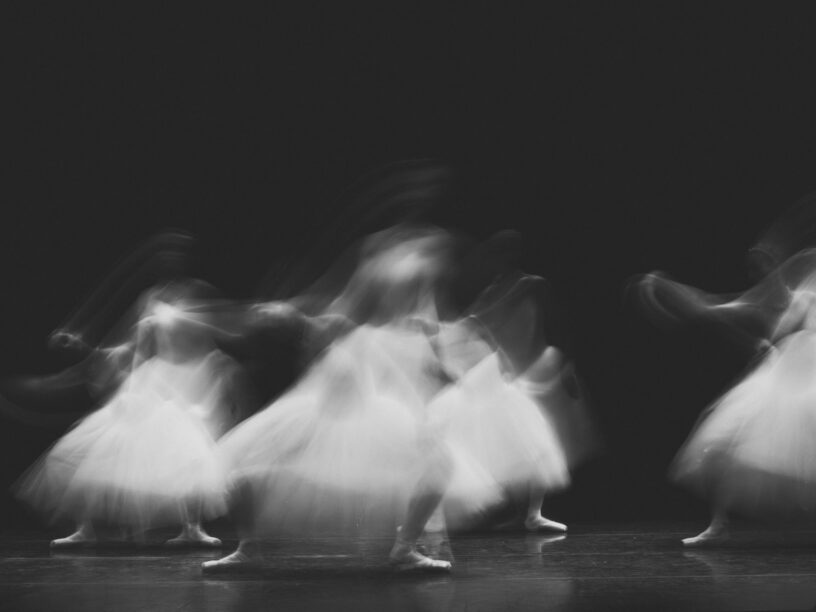
Simon Boxus/Unsplash, CC BY-SA
Bernard Guy, Mines Saint-Etienne – Institut Mines-Télécom
Refining our understanding of time is not only about, in collaboration with physicists, building better clocks. It is also—above all—about reworking our rationality, that is, the way we put words to the world. Here we wish to emphasise the full value and fruitfulness of complex thinking (in Edgar Morin’s sense) about time, as opposed to the Cartesian thinking about it with which we are more familiar.
Complex thinking? Let us take an example, drawn from our lives. How can we express what we are? With Descartes and his cogito ergo sum (“I think, therefore I am”), we believe we build our identity from our own thinking, without reference to anything outside ourselves. This understanding is reassuring, but how can we accept it? All the data from contemporary sciences show us its limits: our relationships with others and with our environment truly make us who we are. What meaning, then, does my “self” have? Where am I? Here and/or elsewhere? We are faced with endless circles.
Complex thinking does not hesitate to confront these difficulties, at the cost of a certain insecurity, but gains a closer connection with reality. It shows the links in every direction between our objects of thought (I am both myself and the sum of my relationships), the unavoidable conventions that must be established, their provisional nature, and the need to continually revisit our representations. It asks us to distinguish between concrete reality, woven from multiple intertwined threads, and the fiction of words that separate. The German philosopher Hans Vaihinger (author of The Philosophy of “As If”) shows that we need words as effective tools of thought (or fictions) that do not necessarily refer to isolated elements of reality.
And time? For it as well, we must abandon the desire to consider it on its own, in itself. To think about time is to consider its relationships with the world, from which we abstract it for the convenience of our understanding.
Time and motion
What should we connect it to first and foremost? A simple examination of its tangible meaning shows us that the time that matters always refers to changes of position in space—that is, to the movements of material entities in the broad sense. For a span of time to be concretely marked, it must correspond to changes in the spatial distribution of the atoms in our universe. Could one imagine time passing without any movement, as when my hair turns white? But if we magnified things, we would see movements of matter. And the operational meaning of time for the physicist rests on a clock that always conceals a movement.
The history of philosophy and physics points us in the same direction. Two examples: for Aristotle, “time is the number of motion according to the before and after”. With these famous words, the philosopher bases himself on motion to define a temporal succession, while also highlighting a distinction between time and motion, discussed at length in his work.
For the physicist E. Mach, “we choose, to measure time, a movement chosen arbitrarily”. Many cultures (for example Chinese culture; see F. Jullien) have done without the concept of time and replaced it with the movements offered by nature: the course of the stars, the movements of the winds, etc., driven by the changes of the seasons…
But how can we speak of motion if we do not already have time? And should space remain outside the discussion, when H. Poincaré tells us it is constructed by the movements we make to connect its constituent points?
With complex thinking, we draw on all the resources of the human and social sciences, the natural sciences, and epistemology. With them, we can promote a synthesis of Mach and Poincaré by asserting the central heuristic proposition: “motion precedes space and time, from which they are derived”.
Anthropology, psychology, and studies on embodied cognition show us how bodily movement precedes the space and time of words; phenomenology insists on the inescapable nature of this step with regard to any natural science, even the most fundamental.
And, given our position within the world, we are not able to step outside it to provide, from the outside, rules and clocks to gauge it. Following a relational approach (another name for complex thinking), we can only compare phenomena with one another; space and time are the names of these comparisons.
[Nearly 70,000 readers trust The Conversation newsletter to better understand the major issues facing the world. Subscribe today]
In each particular situation, the movements of entities in the world can be divided between those that are insignificant to us, or beyond the reach of our instruments—on which we build space and spatial reference points—and, by comparison, those that are significant and on which we build times.
Thus, the surveyed points of the IGN (Institut géographique national) or the reference points of the GPS (Global Positioning System), planted on our terrain and mountains, apparently do not move relative to one another on the human scale: we build our reference space on them, within which we mark various movements associated with time. But on the geological scale, these reference points are mobile and can no longer serve this purpose; we must then shift our concrete space/time duality of reference.
Time, or times?
Time in the singular is chosen from the multiplicity of times for its value in broad communication; it is based on a movement established as a standard by convention (today, that of the photon of light, according to the second postulate of relativity), halting an endless regression: we can then name what we had only pointed to.
In short, let us keep in mind the image (the recipe for thinking) that to every time we associate a movement (open up clocks: they are always a viewpoint on a movement) and to every space a piece of movement (think of geometers who measure distances on Earth by the flight time of laser photons, or astronomers who measure the distance of stars in light-years).
Let us clearly distinguish between concrete space and time—lived, measured, always linked to one another like the two sides of the same coin (the comparison of movements)—and space and time as words isolated from one another, useful fictions, enabling us to speak.
The validity of this time–motion heuristic is tested in its many consequences (see Bergson: the new idea is illuminated by what it illuminates). Thus, in all domains of thought, when it comes to dealing with this or that difficulty, there are serious drawbacks to separating concrete space and time. We must try, as far as possible, to return to the source of motion.
It is fruitful to consider a spatial extent as a piece of motion, giving meaning to the 1983 definition of the metre as the distance travelled by light during a fraction of a second. It is also fruitful to place time and space on the same level, and on the same plane as the different pairs of quantities in physics (electric/magnetic field, for example), offering a new perspective on the relationship between quantum mechanics and general relativity, which oppose one another in their understanding of space and time. The second principle of thermodynamics is clarified by emphasising the strong pairing of spatial and temporal gradients.
It is beneficial to link time, space, and motion in the human and social sciences: this provides welcome insights into the aporias of time, the relationships between history and geography, the convergence of the words for time and space in linguistics, the understanding of rhythms, and the genesis of spatio-temporal notions in anthropology, psychology, and neuroscience, etc.

Bernard Guy, Lecturer and researcher, Mines Saint-Etienne – Institut Mines-Télécom
This article is republished from The Conversation under a Creative Commons licence. Read the original article.