The project by 4 ISMIN engineering students on mass measurement in microgravity has been selected by the French National Centre for Space Studies (CNES): they will develop a prototype for the precise measurement of small objects. This ambitious study project is now being conducted in industrial partnership and developed within the Campus’s prototyping space.
Our sincere congratulations on this brilliantly achieved first step!
The objective of the CNES call for projects was to imagine an experiment to be tested in zero gravity, during a parabolic flight. The project by Baptiste Lefèvre, Mathieu Latournerie, Adèle Perdon and Baptiste Massardier, first-year ISMIN students, has been selected by the French National Centre for Space Studies. They are invited to participate in a parabolic flight campaign in October 2019.
The Problem
“All the balance systems we have are unusable in zero gravity. The only solutions onboard the International Space Station are used for measuring the mass of astronauts, not for precise scientific work.”
There are two systems for measuring the mass of astronauts aboard the International Space Station: the first oscillates the astronaut to be weighed; the second accelerates them linearly. They decided to develop a prototype to offer a reliable and precise measurement solution.
The Prototype
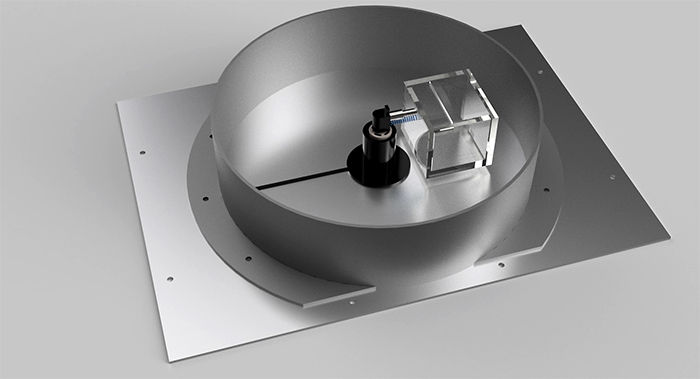
Their mass measurement device is in the form of a centrifuge. A motor rotates a box containing the object to be weighed. Different sensors measure speed, centrifugal force, and acceleration.
Our Partners
Beyond the ongoing exchanges with the CNES as part of their project, our students are developing their experiment within the ID-fab project of Campus G Charpak Provence with the support of Marc Hamand and Roger Delattre.
They also benefit from the technical expertise of engineers from the company Novespace (a CNES subsidiary, organizer of parabolic flight campaigns), to ensure the experiment’s compliance with current safety standards during the flight.
They have also formed a partnership with the company ST Microelectronics, which provides the electronic equipment necessary for the prototype’s manufacturing.
Our students share skills in mechanics, electronics, and computer science and wish to specialize in the space sector:
“This project is a gateway for us into this sector, and we are currently seeking financial partners to bring it to fruition!”
We will follow them in this ambitious project, which highlights a concrete pedagogical approach, R&D expertise, and industrial collaboration, to address an existing technical need. We wish them every success.
Contacts for the Project team: Baptiste Lefèvre, Marc Hamand