
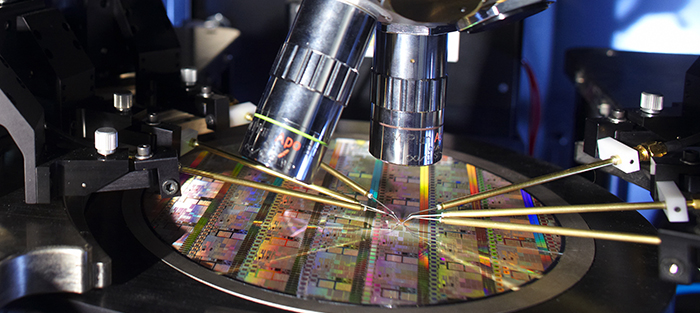
Three projects are hosted or coordinated at the G. Charpak Provence Campus, as part of the 2019 ANR generic call for projects: they respectively concern the securing of IoT objects, the development of stretchable optics, and the creation of textile electronic sensors.
The MISTRAL project: Securing cryptographic algorithms through MRAM/CMOS hybridization
Connected devices have been designed, until now, with strong constraints on power consumption and cost, relegating security to the background. Nevertheless, recent attacks have proven that IoT device security is becoming a major issue. To address this, technical solutions such as lightweight cryptography and the development of countermeasures must be implemented to bridge the gap between security requirements and cost constraints. The implementation of such solutions is a key point for both academic and industrial stakeholders.
A Collaborative Research Project in the Global Security & Cybersecurity category, MISTRAL proposes an innovative MRAM/CMOS hybridization approach for securing cryptographic algorithms against hardware attacks.
To demonstrate the effectiveness of this approach, the consortium intends to study standard configurations, design countermeasures, and characterize the reinforcement of security by integrating STT-MRAM memory cells.
The labeling of this project by the SCS cluster (Secured Communicating Solutions) has been requested and obtained.
The project will rely on the following partners: SPINTEC Grenoble, IM2NP Marseille, CEA-TECH Gardanne, and Mines Saint-Étienne (Secure Systems and Architectures department) Jean-Max Dutertre, Olivier Potin, and Jean-Baptiste Rigaud, project leader.
“OPTISKIN: developing stretchable optics”
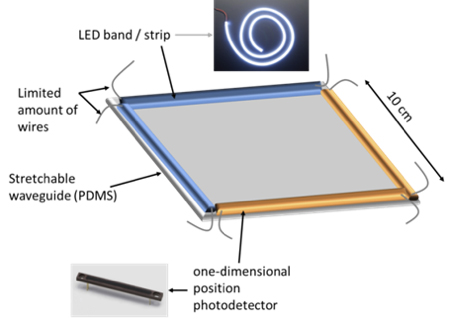
The OPTISKIN project, stretchable optical waveguides for artificial skin applications, has been accepted in the Interaction, Robotics category.
Its objective is to manufacture pressure and temperature sensors using stretchable optical waveguides. By merging stretchable materials and optics, the OPTISKIN project intends to develop stretchable optics for applications such as robotics or prosthetics.
A thesis will be launched within this framework and several interns will be welcomed. This project, under the “Young Researchers” (JCJC) funding instrument, will be supervised by Marc Ramuz, CMP, Flexible Electronics Dept.

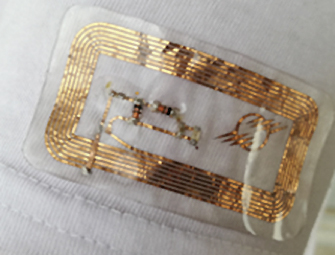
Schematic diagram of the OPTISKIN stretchable optical sensor Example of an electronic circuit on textile @Mines Saint-Étienne
SAFIRS Project : Smart Air Filtration & Remote Sensing
Funding instrument: Collaborative Research Project – Company in the category “Scientific and technological innovations to support the ecological transition” (generic call for projects)
SAFIRS aims to create textile electronic sensors permeable to airflow, to analyze air quality and the energy efficiency of a treatment plant dedicated to air renewal in confined spaces (e.g., offices, hospitals, shopping centers, swimming pools, etc.). For Mines Saint-Étienne, the activity will consist of manufacturing an ultra-flexible electronic circuit for integration onto a textile substrate.
This project, conducted in partnership with IMT Atlantique, ENSAIT Roubaix, as well as two companies, ETT and Titanair, will allow for the hiring of a postdoctoral fellow.
Contact: Marc Ramuz, CMP, Flexible Electronics department