
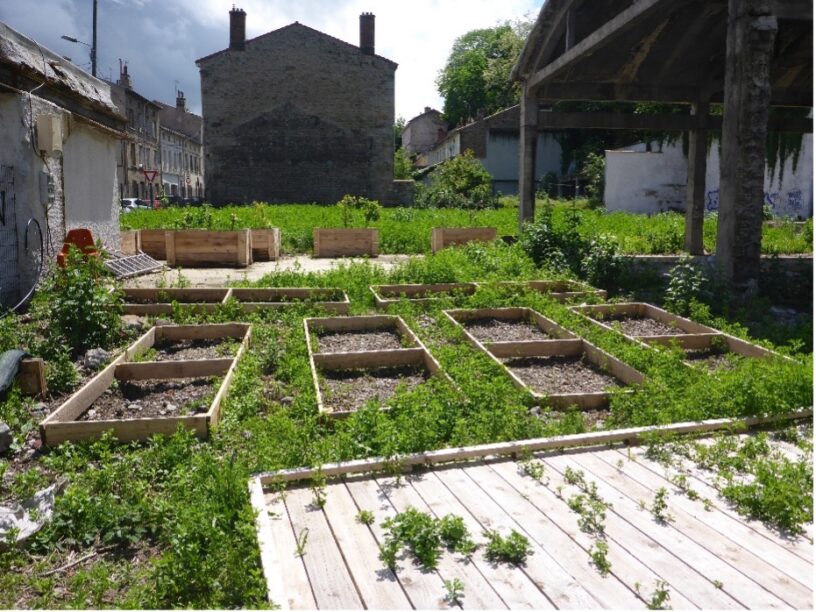
Innovating to rebuild a neighborhood around a popular center and regenerate urban soils.
The Neyron project is part of the national “Sustainable City Demonstrators” programme (France 2030) coordinated by EPASE, and aims to reclaim a 9,000 sqm industrial brownfield in Saint-Étienne (Crêt-de-Roc/Châteaucreux district). Its specificity: a systemic approach by urban layers (subsoil, soil, street level, housing, governance) and co-construction with local stakeholders to “rebuild a neighborhood around a popular center.”
The École des Mines de Saint-Étienne, through the SPIN – UMR 5600 EVS team (Olivier Faure, Frédéric Gallice, Frédéric Paran, Steve Peuble, Rachel Seillier), led the scientific incubation phase on the “soil” layer with two main missions:
- Advancing decontamination practices by integrating the bioavailability of metallic elements in the soil, via detailed analyses on three plots of the site (characterization, transfers, risks, mapping of excess hazards, botanical surveys).
- Testing the feasibility of open-ground urban agriculture, in partnership with the Amicale Laïque du Crêt de Roc, via experimental protocols on various vegetables in both control and contaminated zones.
Preliminary results revealed total metal concentrations that were sometimes very high on the brownfield, but the portion actually transferable to the environment and plants remains limited. Local plant communities show that the soil remains minimally restrictive for growth, and revegetation would be possible with simple interventions, without a massive influx of topsoil.
An agricultural experiment was conducted on nine vegetable species, covering leaves, fruits, and roots, in control and contaminated zones. Analyses show that, in the control zone, cadmium and arsenic levels remain below regulatory thresholds, with no overexposure compared to local vegetables.
These results highlight the value of a local and integrated approach to diagnosing and managing contaminated sites, and pave the way for low-impact, adapted practices for the ecological conversion of urban brownfields.
Partners
- Centre for Chemical Engineering
- UMR 5600 EVS
- EPASE
- Amicale laïque du Crêt de Roc
- Ferme des renouées
- Tesora
- Banque des Territoires
- City of Saint-Étienne
- Local associations
Key Figures


