The objective of a mobility plan is to propose actions conducive to limiting automobile traffic, particularly that of vehicles with a single occupant (solo drivers). The priority of Mines Saint-Étienne is to promote sustainable mobility through the promotion and support of alternative mobility options and “soft mobility” modes.
Active mobility, to get moving
In terms of soft mobility, the staff and students of Mines Saint-Étienne benefit from equipment and incentive measures to strengthen the use of bicycles and scooters.
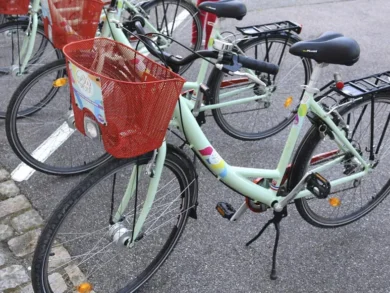
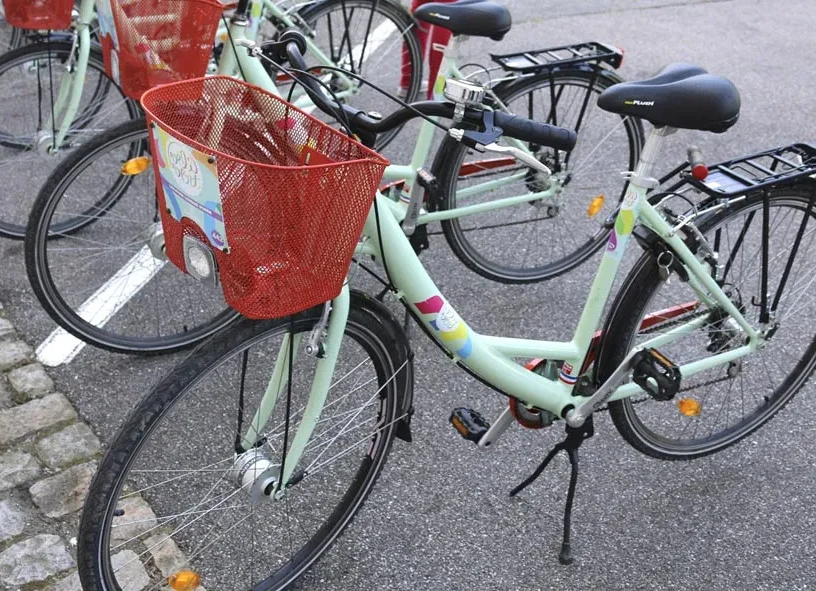
Thus, concerning inter-campus travel and within the perimeter of the Saint-Étienne metropolitan area, Saint-Étienne Métropole donated 20 bicycles, most of which are made available to students and their VéloME association. School staff can also freely use them, some as “service bikes” for on-campus travel.
In order to encourage the use of more environmentally responsible modes of transport, a “sustainable mobility allowance” has been implemented for staff within the Institut Mines-Télécom. Amounting to up to €200, it encourages the use of bicycles, scooters, or carpooling for home-to-work commutes.
In addition to these measures, employees paid by the School can benefit from reimbursement of subscription fees for a public bicycle rental service.
These provisions are accompanied by the implementation of specific equipment such as dedicated secure parking spaces (bike racks or shelters) on our campuses. In parallel, communication campaigns on bicycle use and “active mobility” are conducted, particularly within the framework of student projects.
Thus, for all short-distance urban travel, Mines Saint-Étienne intends to promote walking, cycling, or public transport. A student project, carried out as part of the mandatory civic projects in the first year during the 2020/2021 academic year, led to displays on the Saint-Étienne sites (see photos of the posters below) as well as the organization of a treasure hunt in the city of Saint-Étienne, leading players (students and school staff) to discover and experience alternative modes of transport to the car: bicycle, walking, bus, tram.
By train or bus, it’s better than alone in a car
Prioritizing public transport over the car, whenever possible, is therefore also one of our priorities. Consequently, transport tickets are available to staff for professional travel within the perimeters of the Saint-Étienne, Lyon, and Aix-Marseille-Provence metropolitan areas. Similarly, all School employees can benefit from partial reimbursement of annual, monthly, or weekly multimodal subscription fees (such as SNCF and Navigo) for home-to-work commutes.
For their professional travel, employees are strongly encouraged to use public transport (all professional travel is reimbursed at the SNCF 2nd class rate, even if it is made with a personal vehicle).
On our Saint-Étienne sites, these actions are part of the Inter-Campus Mobility Plan coordinated by Saint-Étienne Métropole in order to create a discussion space between higher education institutions and transport organizing authorities (Saint-Étienne Métropole, STAS) to best adapt the offer (in public transport, cycling facilities, etc.) to needs. This inter-campus mobility plan aims to promote the use of public transport on the urban transport network of the metropolitan area and allows Mines Saint-Étienne staff in Saint-Étienne to benefit from a discount on subscriptions greater than the standard employer contribution.
For all Saint-Étienne students under 26 years old, a very attractive subscription at a cost of €10 per month provides access to the entire STAS network (Société de Transports de l’Agglomération Stéphanoise), the public transport operator of Saint-Étienne Métropole. During an on-site session at the Mines Saint-Étienne Campus, STAS interacts with students and staff to facilitate subscription to public transport passes.
By car, but shared or electric
For several years, the vehicle fleet of Mines Saint-Étienne has consisted primarily of small electric city cars. They are available to staff for professional travel when no other mode of transport is reasonably feasible.
Still within the framework of the exemplary mobility policy, Mines Saint-Étienne is a member of the CITIZ car-sharing cooperative, a partner of the majority of car-sharing networks in France. This allows its employees to use, for their professional assignments, the vehicles of the Citiz cooperative across their entire network, thus providing the possibility of combining public transport and car-sharing to cover the last kilometers when the assignment location is far from the train station.
The aforementioned “sustainable mobility allowance” also encourages staff carpooling initiatives.
The trips that pollute the least are those we avoid
The health crisis has profoundly changed work habits and has prompted numerous reflections on the appropriateness and efficiency of teleworking. As 2020 has shown, these measures are not neutral in terms of mobility and reduction of environmental impact.
Mines Saint-Étienne has implemented a teleworking trial phase, entitled “Teleworking arrangements as of February 1, 2021 (or outside health crisis) Teleworking charter and trial.” According to several modalities, the experiment will be launched after the crisis to evaluate the relevance and impact of this new type of work organization.