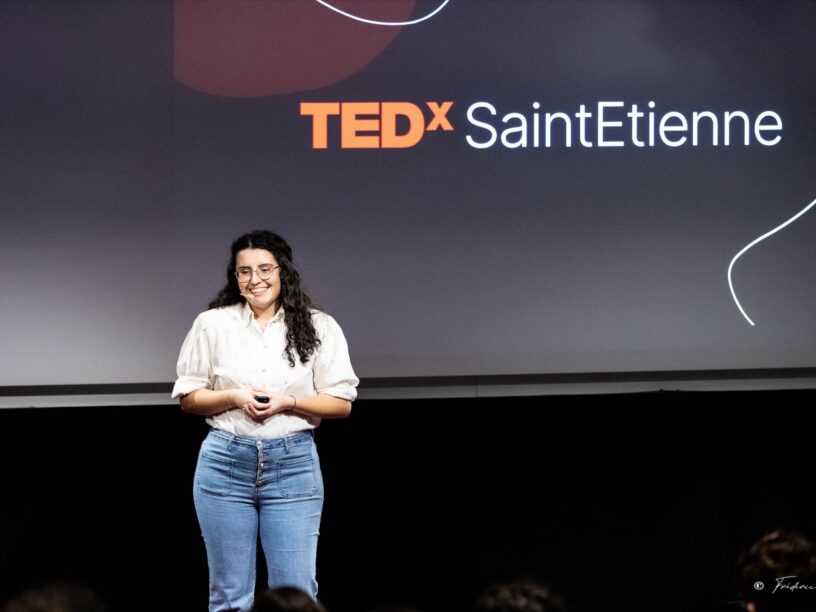
Doctoral candidate for ADEME (French Agency for Ecological Transition) and the Eco-design Center, Mélissa Bounouar is writing her thesis in environmental sciences. She was selected by the TEDxSaintEtienne team to participate in the 2025 edition and showcase her research work: particularly her expertise on planetary boundaries.
Now highly popular, TED (Technology, Entertainment and Design) conferences take the format of short, eloquent, and stimulating talks, capable of captivating audiences and enabling the popularization and sharing of ideas.
TEDxSaintEtienne selects ideas presented by local personalities from the Loire region, and it was Natacha Gondran, a faculty researcher at the Fayol Institute, who encouraged our doctoral candidate to take the plunge.
In this article, Melissa Bounouar answers our questions and reflects on her academic journey and this public speaking experience.
Can you tell us about your academic background?
After obtaining my scientific baccalaureate at Claude Fauriel High School in Saint-Étienne, I completed two years of preparatory classes in physics-chemistry at the same school, before joining IMT Nord Europe to pursue their general engineering program, with a specialization in energy and environment. Following this, I wanted to specialize in environmental assessment, which led me to complete a second master’s degree in “Environmental Assessment and Risk Sciences” at Mines Saint-Étienne.
During that year, I took a course that particularly interested me on Life Cycle Analysis and carbon footprint, taught by Natacha Gondran, with an introduction to the planetary boundaries framework. I then expressed my interest to her, which led to a research internship at the Eco-design Center to study the potential for integrating the planetary boundaries framework into eco-design.
This work formed the basis of the thesis topic that we submitted, with Mines Saint-Étienne and the Eco-design Center, in response to ADEME’s Thesis Project Call.
And that’s how I arrived at my second year of doctoral studies in environmental sciences!
How do TEDx conferences work?
Initially, the organizing team contacted the school, and it was my supervisor Natacha Gondran who put me in touch with Anne Chaillan, the organizer. We had an initial meeting for her to present the project to me, the commitment it entails, the selection process, and also to see if my topic aligned with the 2025 theme: cycles and re-cycles. And it was really after that exchange that I wanted to submit my application to try my luck. Obviously it’s a great opportunity to learn how to present one’s work in an accessible and engaging way to an audience other than the one we’re used to in research. But what motivated me most was the fact that it’s a collective experience, with all the speakers and volunteers, to create this event from A to Z for the public. We receive support in writing our text, we rehearse together and give each other advice. We’re also coached to learn how to project our voice, occupy the stage space, and manage stress. And as someone who grew up in the Saint-Étienne region, I was all the more motivated to participate in a local event!
Do you think such a format can help raise awareness about planetary boundaries?
In my opinion, there isn’t one way of raising awareness that is fundamentally better than others, simply a multitude of ways to raise awareness adapted to different audiences, whether through conferences, performances, comic books, games, etc.
For me, scientific articles constitute the solid foundation on which to base awareness-raising efforts: they guarantee the validity of what we put forward. But they generally address an expert audience, already familiar with the subject. The whole point is therefore to succeed in extracting a message to convey using science communication tools. And mastering these tools is a skill in its own right, which is different from simply mastering one’s subject.
Do you plan to participate in other conferences to showcase your research work?
I really enjoyed the experience, so why not do it again for a different audience, or with a different approach (with a touch of humor perhaps?). But I prefer not to commit myself at the risk of spreading myself too thin, as my supervisors Natacha and Audrey remind me. To have new topics to popularize, I first need to defend my thesis!
We thank Melissa for her responses and congratulate her on her research work as well as her presentation at TEDxSaintEtienne. We are proud to showcase the young engineers from our School. They bring recognition to our institution’s research and contribute to building a better future.