This May, CIS and the Fayol Institute are bringing us some excellent international news.
Naoki Yoshida, a dual-degree student with Kyushu Institute of Technology and Mines Saint-Étienne, joined the Materials Master of Science in Engineering program at CIS.
🧑🏻🎓 Could you tell us about your academic background?
I am a Master’s student as part of a double-degree programme between the Kyushu Institute of Technology (JP) and Mines Saint-Étienne. My studies focus on materials science. I began my studies in Japan and am now continuing them in France to experience a more international environment. It is a unique opportunity to broaden my academic and personal horizons.
🧑🏻🎓 What will French education bring to your Japanese academic path?
Above all, what stands out is openness to others. Here, I have the opportunity to talk with many more people and about a much wider range of topics, whether related to research or not. These constant exchanges with people from all over the world greatly enrich the way I think. This social and international dimension—this ease of communicating about anything and with everyone—is the greatest advantage compared with my experience in Japan.
🧑🏻🎓 Could you tell us about your master’s project?
I am working on hydrogel kinetics at the Centre for Engineering and Health (CIS). What I particularly appreciate is the collective aspect of the project. I truly feel that my research is moving forward by collaborating with many people within the laboratory. It is a team effort where everyone helps, which makes the process very motivating. People are very supportive, which creates an excellent working atmosphere.
👉 Among cartilage tissue regeneration strategies, the administration of autologous cells with a supporting hydrogel has often been considered. How chondrocytes delivered within a polymer matrix can mature, and the biological mechanisms leading to functional tissue, are crucial questions for developing better treatments.
🧑🏻🎓 What has struck you most about French culture since you arrived?
The culture of greetings in France has touched me deeply. Even though we of course have a greeting culture in Japan, the way people say “Hello” here is particularly warm and human. It is a simple but wonderful moment that makes everyday life more pleasant. In addition, the interest in anime and manga is also a great bridge that makes it easy to connect with others. It is a pleasure to discover all these facets of French life, which are so positive.
Fernando Cezar on a research stay at the University of São Paulo
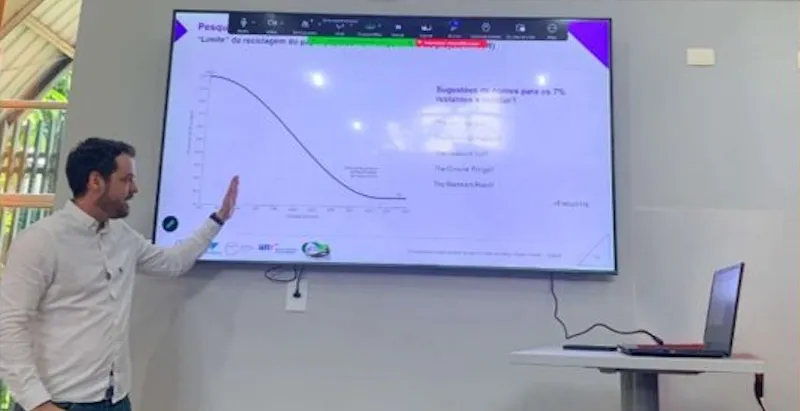
From 9 to 20 March, Fernando Cezar, a postdoctoral researcher at Mines Saint-Étienne and a member of the COACTIS laboratory, travelled to the University of São Paulo (USP) in Brazil to strengthen scientific exchanges and initiate new collaborations with our Brazilian counterparts.
On this occasion, he presented work carried out as part of the PAC3R and Symbiose ZAAB projects, in which Sophie Peillon, a lecturer-researcher at the Henri Fayol Institute and member of the COACTIS Laboratory, and Valérie Laforest, a lecturer-researcher at the Henri Fayol Institute and member of the EVS laboratory, also participate. These projects aim to develop innovative circular economy solutions and to structure sustainable industrial ecosystems.
During a presentation within CEPID BRIDGE at the FEAUSP Academy, Fernando Cezar shared his research on the circular ecosystem of the paper and cardboard sector in France. This work is part of the PAC3R project, whose ambition is to recover non-recyclable waste and propose new business models for the entire sector.
This stay reflects the international momentum of the Fayol Institute and its commitment to interdisciplinary research in support of industrial and environmental transitions.
A week of scientific collaboration in Brazil for Arthur Kramer
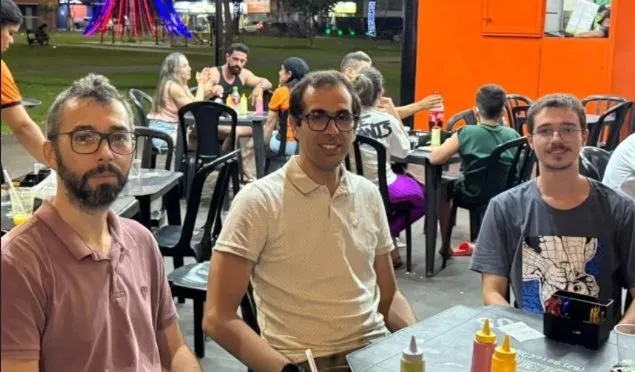
From 2 to 6 March 2026, Arthur Kramer, a lecturer-researcher at the Henri Fayol Institute and a member of LIMOS (UMR 6158), travelled to the Institute of Mathematics and Statistics at the Federal University of Goiás (UFG) in Goiânia (Brazil), as part of an international scientific collaboration underway since 2019 with Thiago Alves de Queiroz, Associate Professor at UFG.
During this visit, Arthur Kramer led a seminar for IME-UFG students and lecturer-researchers. This session presented the activities of the Henri Fayol Institute, with a particular focus on the Mathematical and Industrial Engineering (GMI) department, as well as work on the mathematical modelling of task scheduling problems with setup times.
This mobility is part of the research project “Combinando inteligência artificial e otimização para lidar com problemas difíceis e práticos de escalonamento de tarefas”, funded by CNPq (Brazil) for the 2025–2026 period. The project aims to combine artificial intelligence and combinatorial optimisation to address complex task scheduling problems that incorporate stochastic aspects.
The working week also provided an opportunity to meet with Ruan Magalhães de Oliveira, a former intern in the GMI department in 2024, now based in Goiânia, and to discuss continuing and strengthening collaboration between the teams.
This mission helps consolidate the international partnerships of the Henri Fayol Institute and develop joint research projects around optimisation and artificial intelligence.