On March 24, Explora Provence will launch its programmes on the Aix-Marseille-Provence campus with a conference entitled “The oceans, the planet’s blue lungs: are they suffocating? “, led by CNRS researcher Guillaume Leduc.
To mark the occasion, we look back at the deployment of La Rotonde’s missions on the Gardanne campus by asking Estelle Nakul a few questions. Head of Explora Provence since December 2025, Estelle holds a PhD in neuroscience and is responsible for developing this new cultural venue as well as maintaining the link with La Rotonde in the Provence-Alpes-Côte d’Azur region.
Can you tell us about your missions as Head of Explora Provence?
I am responsible for the installation and deployment of the Explora Provence concept, its programmes, including the facilitation and design of workshops and events, and I develop science discovery and education projects with local partners. In short, I develop and manage this new cultural venue and serve as a liaison for La Rotonde in the Provence-Alpes-Côte d’Azur region.
What will Explora Provence bring to the Gardanne campus?
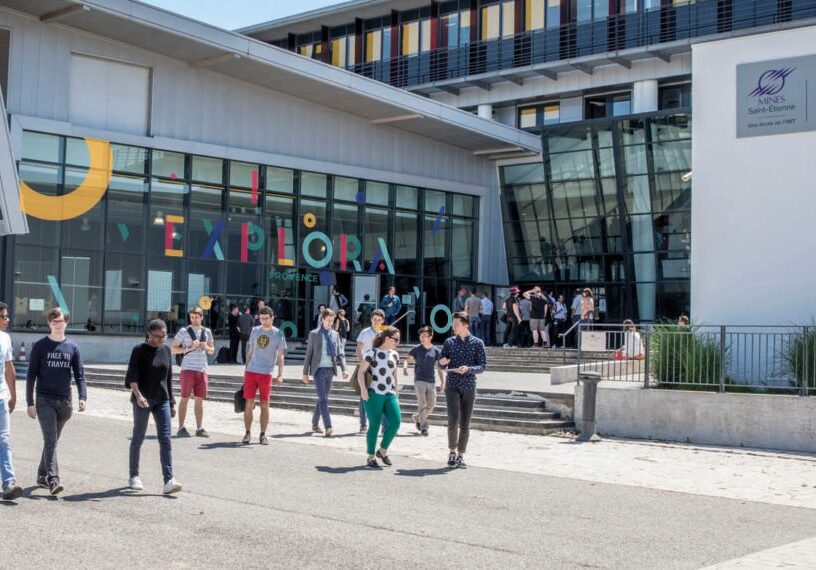
Explora Provence is a new space for experimentation, hands-on activities, and mediation to understand science through making, located in Gardanne. This venue is supported by La Rotonde, the Centre for Scientific, Technical and Industrial Culture of the École des Mines de Saint-Étienne, and is located on the Aix-Marseille-Provence campus. Explora Provence is expected to move into the new SPOT building in 2027, to be a cultural venue accessible to everyone at the heart of the science and innovation ecosystem.
Starting in March 2026, Explora Provence will launch its prefiguration programmes in Gardanne. Explora Provence adapts the Explora Saint-Étienne concept, which has been very successful for 5 years and is therefore based on a proven model. Its prefiguration programmes are currently aimed at the general public from age 6, schools, and leisure centers, with workshops and events both on and off-site. We hope to offer workshops for younger children, from age 3, by the end of 2026. When Explora Provence moves into the SPOT building, we will be able to expand our range of workshops and events and also offer interactive exhibitions.
👉 It is worth noting that La Rotonde has already been present in Gardanne for several years. The arrival of Explora Provence allows for a scale-up, to develop more projects and to contribute to greater openness and accessibility of the Aix-Marseille-Provence campus for everyone. It also marks the creation of a new scientific culture venue in Gardanne, which will improve the local cultural offering and help reach remote and disadvantaged audiences in terms of access to science.
Can you tell us about the conference “The oceans, the planet’s blue lungs: are they suffocating?”
As part of its prefiguration programmes, Explora Provence is launching the “Explora Provence Encounters”: conferences accessible to the widest possible audience to discover ongoing research on key themes in the Provence-Alpes-Côte d’Azur region.
Between March and June 2026, we plan to organize 4 evening conferences during the week, one per month. These conferences will take place either directly on the Aix-Marseille-Provence campus, where Explora Provence is located, or at the Gardanne media library, our partner.
The conference “The oceans, the planet’s blue lungs: are they suffocating?” is led by Guillaume Leduc, a CNRS researcher at the CEREGE laboratory (European Centre for Research and Teaching in Environmental Geosciences). It is accessible from age 13 and, as with all Explora Provence Encounters, the goal is to present a current research topic in an accessible way for about 45 minutes, followed by a 15-minute discussion between researchers and the audience.
Each Encounter is accompanied by live graphic facilitation to create a mini-comic, which will be shared on social media a few days after the conference and printed for display at Explora Provence and during scientific culture events on or off-site.
👉 Few people know that vast oceanic zones are naturally devoid of oxygen. Paleoclimatology tells us that these zones have, in the past, expanded or disappeared depending on climate change. This conference will explain how and why these zones are present in the ocean, and how they are likely to evolve in response to global warming and overfishing.
The date is set: Tuesday, March 24, 2026, at 6:00 PM, on the Aix-Marseille-Provence campus!