
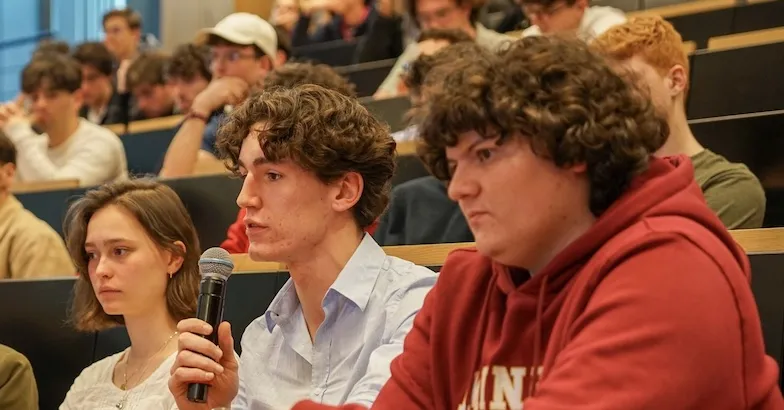
Enzo EYNARD and Sacha MALRIC are students at Mines Saint-Étienne in a dual degree programme with emlyon. They are committed to bridging the worlds of engineering and finance, and this path has led them to create their start-up Olorin. Today, they reflect on their journey, recently crowned by winning the MINOV 2026 Grant and their success in the H7 competition organized by the Lyon Bar Association.
Can you tell us about your dual programme at Mines Saint-Etienne and emlyon?
This dual programme is a particularly enriching experience, as it places us at the intersection of two worlds: cutting-edge engineering and business strategy. What makes this programme strong, in my opinion, is the confrontation of often opposing but fundamentally complementary visions. On one hand, Mines Saint-Étienne provides us with rigor and technical excellence supported by high-level infrastructure. On the other hand, emlyon, through initiatives such as the PCE (Business Creation Project), enables us to bring a commercial, marketing, and strategic dimension to our technical projects. Finally, we benefit from the strength of two exceptional alumni networks. Having access to committed and attentive mentors, such as Yann Person, is a major asset for navigating any sector of activity and accelerating our skill development.
You won the MINOV Grant and the H7 competition organized by the Lyon Bar Association—how did your dual programme prepare you for this?
Our preparation is based on the immediate application of academic concepts. Experiences such as the PCE or the first-year business simulation enabled us to approach these competitions with much greater confidence. We learned to structure a pitch and defend a business model thanks to the constant support of professors and expert speakers.
The idea to enter came from a project I was initially developing on my own: a solution aimed at modernizing transactions toward digital finance via DLT (Distributed Ledger Technology). The MINOV Grant was the perfect opportunity to test this idea against external perspectives, refine it, and obtain the initial funding necessary for technical development (API, servers, infrastructure).
For H7, the challenge was different: we were seeking institutional validation from the legal sector. This competition allowed us to present our vision directly to legal experts and potential clients, thereby confirming the relevance of our solution in the transactional process.
At the same time, you created your start-up Olorin—can you tell us about it?
Olorin is a SaaS platform that reinvents the most critical moment for a business: its transfer.
Today, the sale of an SME is a cumbersome process, marked by weeks of administrative friction, fragmented communications, and stressful “dead times” between signing and the actual transfer of funds. We designed Olorin to transform this chaos into a seamless experience. Our platform synchronizes document and fund flows in real time between lawyers, buyers, and sellers.
The innovation at the heart of Olorin is based on leveraging Web3 technologies to secure these exchanges. Unlike traditional methods, we use blockchain as a programmable trusted third party. This enables us to achieve “Atomic Settlement”: a protocol that ensures the transfer of funds is triggered only if, and only if, all legal conditions are validated and documents are signed. By combining the power of smart contracts with regulated euros, we transform a manual administrative process into an instant, transparent, and tamper-proof digital transaction.
After such successes, what’s next for your projects?
What’s next is real-world testing.
We now have two major validations: technical validation with the MINOV grant, which enabled us to prove the robustness of our Web3 infrastructure, and market validation with our selection by the Lyon Bar Association and H7, which confirms professionals’ interest in our solution.
Our immediate priority is finalizing the MVP (Minimum Viable Product). The goal is to transform our prototypes into a seamless user interface capable of managing real end-to-end transactions.
To achieve this, we are entering a crucial phase: deployment with our pilot firms. These first users are essential because they will allow us to test Olorin in real-world conditions and gather direct customer feedback. This iteration will enable us to refine the product so that it perfectly meets the security and usability requirements of lawyers and accountants.
The summer challenge is simple: transform these institutional successes into operational successes, before a broader rollout of the service.
Thank you to Enzo and Sacha for answering our questions! We congratulate them on these outstanding achievements and wish Olorin great prosperity. The multidisciplinary nature of their programme is an example of perseverance that will, we hope, inspire other young engineers!