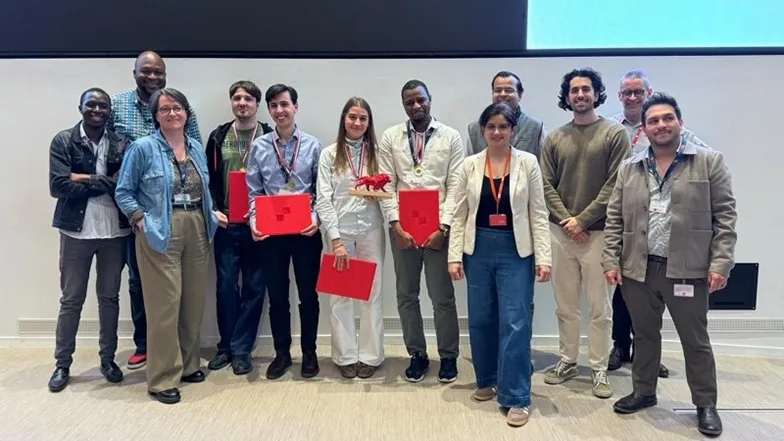
Two students pursuing a dual degree at ISMIN / emlyon participated in the Health Systems Innovation Lab Hackathon organized by the Harvard T.H Chan School of Public Health, a prestigious higher education institution in health based in Boston.
This French edition is taking place at emlyon and focuses on designing high-value healthcare systems leveraging cutting-edge AI technologies to improve patient outcomes, reduce costs, and enhance accessibility.
This competition is open to students and healthcare professionals, and this year, our students Alexandra Baron and Sacha Cohen (ISMIN / emlyon Business Mediation) won it with their EpiWatch project. They reflect on their experience:
👨🏽⚕️ Tell us about your dual academic path at Mines Saint-Étienne and emlyon.
The Mines Saint-Étienne / emlyon dual degree represents two schools, two cultures, two ways of thinking. And it is precisely this combination that allowed us to develop a project like EpiWatch.
At Mines Saint-Étienne, we learned to build things that are robust. When developing a predictive model for hundreds of health zones, the pipeline must be robust, the validation rigorous, and we must be honest about our results. This is engineering rigor.
At emlyon, we learned to ask the question “for whom?”. You can have the best model in the world, but if no one uses it, it’s useless. How do we present it to an epidemiologist? How do we transition from a prototype to an operational tool? This is the business and impact dimension.
The dual degree gave us exactly the two skills we needed: the ability to build the technical engine and connect it to the real world.
👨🏽⚕️ How did you come up with the idea to register for the Harvard HSIL Hackathon France 2026?
emlyon had announced that a hackathon organized by the Harvard Health Systems Innovation Lab would take place on the Lyon campus, at the intersection of health and artificial intelligence. The topic was open, we had to find a concrete problem to solve ourselves.
We became interested in cholera because we saw a huge discrepancy: open-source data exists, machine learning tools exist, but no one is putting them together operationally to anticipate epidemics. We thought it was the right subject.
What convinced us to register is that it’s not a typical hackathon where you code a prototype in 48 hours and forget about it on Monday. The HSIL has a venture building programme behind it, with mentors, field experts, and a framework to transform an idea into something deployable.
What truly motivated us was access to people on the ground. We can code the best algorithm in the world from Lyon or Saint-Étienne, but if we don’t get feedback from an epidemiologist, we risk building something theoretically perfect but practically useless. The HSIL provided us with this bridge.
👨🏽⚕️ What sparked your interest in healthcare systems?
What struck us was the discrepancy. Today, in the private sector, machine learning is used to predict a user’s click on an advertisement down to the millisecond. Yet, in some countries, we still cannot anticipate an epidemic a month in advance, even though the data to do so is available open-source.
Cholera is the perfect example of this discrepancy. It’s a disease we know how to treat, how to prevent. No one should die from cholera in 2026. But thousands of people die from it every year, not because we lack treatment, but because resources arrive too late in the wrong place. It’s a logistical and informational problem. And that’s an engineer’s problem.
What fascinates us is this intersection between pure technical skill and direct human impact. It’s not abstract data science; these are decisions that can concretely save lives.
👨🏽⚕️ Can you tell us about EpiWatch and your future projects?
EpiWatch is an early warning system for epidemic diseases. We cross-reference several open data sources (satellite, climatic, health, geographical) to estimate, zone by zone, the probability of an outbreak in the coming weeks and months.
We started with cholera in the Democratic Republic of Congo as a proof of concept, because it is a country with a long data history and a real operational need. We are working at a much finer resolution than what is usually done, directly at the scale of health zones. What matters to us is that the probabilities are reliable: when the model indicates a high risk, it must correspond to reality.
What we wanted to do differently from classical academic work was to align with existing decision protocols on the ground. We worked with experts via the HSIL programme so that our outputs trigger concrete actions: reinforced surveillance, pre-positioning of stocks, vaccine requests. We are not reinventing the wheel; we are integrating into existing response systems.
The long-term ambition is to scale across the entire African continent, and not just for cholera. The methodology is designed to be replicable for other epidemic diseases with the same types of open data. The goal is to shift from a reactive approach, where teams are sent when an epidemic has already exploded, to an anticipatory approach, where resources are pre-positioned before it begins.
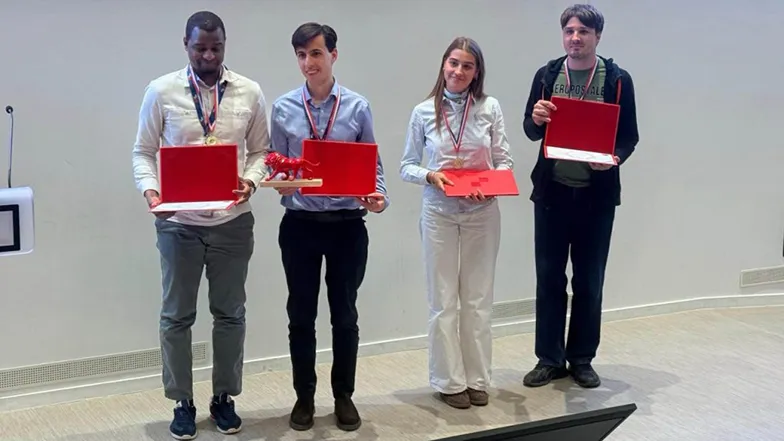
🏆 Many thanks to Alexandra and Sacha for answering our questions! We congratulate them on this great victory and thank them for highlighting the multidisciplinary nature of our engineering students at Mines Saint-Étienne. Their journey is an example of adaptability and curiosity that will, we hope, inspire other young engineers!