A first for the School: the consolidation of analysis instruments from two teaching and research centers will increase our visibility in terms of training for students and doctoral candidates, and offer a more structured service for companies.
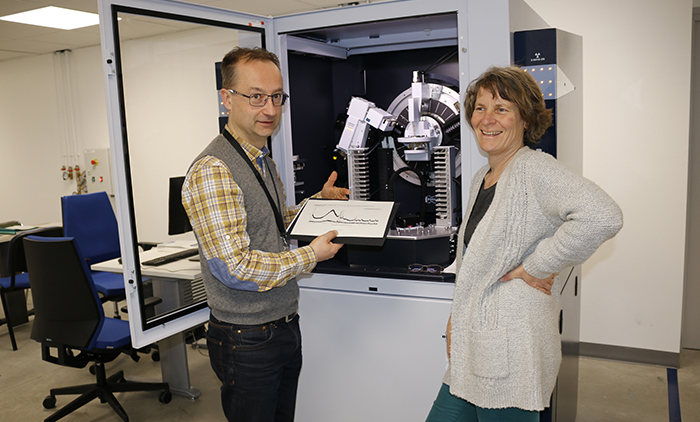
The SMS and SPIN centers will consolidate their analysis resources in a single location (6 pieces of equipment in total) for better identification of our activities using X-ray equipment.
The investment in two new pieces of equipment complements the current resources. They will enable the implementation of advanced techniques and provide exceptional specificities (analysis speed, precision, etc.), thanks to the latest generation equipment co-financed by the Auvergne Rhône-Alpes Region.
The analysis platform will serve both the activities of the school’s centers and the development of new projects that will require cross-functional expertise in materials and processes.
It will be jointly managed by Nathalie Peillon and Olivier Valfort.
The current configuration (techniques and analysis resources) includes two characterization techniques:
- X-ray diffraction, which provides information on the structure and organization of crystalline matter; it is divided into 2 poles:
- The “polycrystalline materials” pole, commonly referred to as “powders” (a new device was delivered in early 2018), allows for the qualitative and quantitative determination of compounds, at room temperature or in a heating chamber, with access to microstructural data,
- the “bulk materials” pole, providing access to textures, residual stresses, dislocation density, and reflectometry on thin layers.
- X-ray absorption tomography, which allows for 3D visualization of an object after acquiring 2D radiographic projections from different angles (the update of the data processing system will notably save time and enable more refined studies).
The latest investment, as part of the IRICE (Research and Innovation Infrastructure Focused on Companies) project, is dedicated to measuring residual stresses, particularly for parts produced by additive manufacturing processes (delivery scheduled for autumn 2018).
The total operation amounts to €540,000 (of which €350,000 is dedicated to the machines). This development is a relevant response to industrial demand, as this support for industry represents 70% of the centers’ activities (particularly via ARMINES and CNRS research units).
Extensive work began at the end of 2016 for the development of a dedicated space in the basement of building D: the relocation of the current equipment from both centers will take place in summer 2018.
This new X-ray platform will be inaugurated at the end of the year and will be the subject of visits and demonstrations.
Heartfelt thanks are extended to all those who are working to make this major project feasible, particularly the school’s support teams: the Real Estate and General Resources Department for the design of the room and the installation of the equipment, the Purchasing/Procurement Department for the financial arrangements, and the staff of the SMS and SPIN centers involved in this project.